Author: Mohammed Haque

  • Share based payments

    Share-based payment is a method of compensating employees or other parties using the entity’s own equity instruments, such as shares or share options. International Financial Reporting Standard 2 (IFRS 2), “Share-Based Payment,” provides guidance on the accounting treatment of share-based payment transactions.

    According to IFRS 2, a share-based payment arrangement is a contract between an entity and the recipient of the share-based payment, in which the entity agrees to provide the recipient with equity instruments of the entity, or cash in lieu of the equity instruments, in exchange for goods or services received. The equity instruments may be shares, share options, or other instruments that will be settled in the entity’s own shares or share options.

    IFRS 2 requires entities to recognize the fair value of the goods or services received under a share-based payment arrangement as an expense in the income statement. The fair value of the goods or services is determined at the date at which the recipient completes the performance of the services or other conditions for vesting of the equity instruments.

    The fair value of the equity instruments issued under a share-based payment arrangement is also recognized as an expense in the income statement. The fair value of the equity instruments is determined at the date at which the recipient completes the performance of the services or other conditions for vesting of the equity instruments.

    IFRS 2 includes guidance on the measurement of the fair value of the goods or services received under a share-based payment arrangement. The fair value of the goods or services may be determined using either a fair value model or an attribution model.

    The fair value model is based on the fair value of the equity instruments issued or to be issued under the share-based payment arrangement. The fair value of the equity instruments is determined using a valuation technique, such as a Black-Scholes option pricing model. The fair value of the goods or services is then determined by multiplying the number of equity instruments issued or to be issued by the fair value of the equity instruments.

    The attribution model is based on the grant-date fair value of the goods or services received by the recipient. The grant-date fair value of the goods or services is determined using a valuation technique, such as a present value calculation based on the expected cash flows from the goods or services. The fair value of the goods or services is then determined by allocating the grant-date fair value of the goods or services to the vesting period of the equity instruments.

    IFRS 2 also includes guidance on the accounting for modifications of share-based payment arrangements. A modification of a share-based payment arrangement is a change to the original terms of the arrangement that results in a change in the fair value of the goods or services received, or the number or fair value of the equity instruments issued or to be issued.

    If a modification of a share-based payment arrangement results in a change in the fair value of the goods or services received, or the number or fair value of the equity instruments issued or to be issued, the entity is required to recognize the incremental fair value of the goods or services received as an expense in the income statement. The incremental fair value of the goods or services is determined by comparing the fair value of the goods or services received before and after the modification.

    If a modification of a share-based payment arrangement does not result in a change in the fair value of the goods or services received, or the number or fair value of the equity instruments issued or to be issued, the entity is not required to recognize the modification as an expense in the income statement.

    Black-Scholes model

    The Black-Scholes model is a mathematical model used to determine the fair value of a European call or put option, using the current market price of the underlying asset, the option’s exercise price, the option’s time to expiration, the underlying asset’s volatility, and the risk-free interest rate.

    To use the Black-Scholes model, the user inputs the current market price of the underlying asset, the option’s exercise price, the option’s time to expiration, the underlying asset’s volatility, and the risk-free interest rate. The model then uses a set of equations to calculate the fair value of the option.

  • Intangible assets (UK)

    Intangible assets are non-physical assets that are identifiable and have a useful life that extends beyond one year. Examples of intangible assets include trademarks, copyrights, patents, and customer relationships. FRS 102, the financial reporting standard that applies in the United Kingdom, includes detailed guidance on the accounting treatment of intangible assets.

    According to FRS 102, intangible assets are initially recognized in the financial statements at their cost, which is the amount paid to acquire the assets, plus any directly attributable costs of bringing the assets to their present location and condition. The cost of an intangible asset may include various components, such as the purchase price, any legal or professional fees, and any directly attributable costs of development or registration.

    Once assets are recognized, FRS 102 requires entities to apply the amortization method to allocate their cost over their useful lives. Amortization is the systematic allocation of the amortizable amount of an intangible asset over its useful life. The useful life of an intangible asset is the period over which it is expected to generate economic benefits for the entity. The amortizable amount of an intangible asset is its initial cost, less its residual value.

    The residual value of an intangible asset is the estimated amount that the entity expects to receive from the sale or disposal of the asset at the end of its useful life. FRS 102 requires entities to review the assumptions used to determine the useful lives and residual values of their intangible assets on an annual basis, and to make any necessary adjustments. For example, if an entity expects a patent to have a useful life of 10 years, but it is only granted protection for 8 years, the entity would need to adjust the useful life and residual value of the asset.

    The maximum permitted useful life of intangibles is generally 10 years.

    FRS 102 also includes guidance on the disclosure of intangible assets in the financial statements. Entities are required to disclose the carrying amount of their intangible assets, as well as the methods and assumptions used in determining their useful lives and residual values. They are also required to disclose any impairments of their intangible assets, and any changes in the methods or assumptions used to determine their useful lives and residual values.

    In addition, FRS 102 includes specific guidance on the accounting treatment of internally generated intangible assets. These are intangible assets that are developed or acquired by an entity through its own efforts, rather than through a purchase or acquisition. Examples of internally generated intangible assets include software developed in-house, and customer lists developed through marketing activities.

    FRS 102 requires entities to recognize internally generated intangible assets only if they meet the same recognition criteria as other intangible assets. This means that the intangible asset must be expected to provide future economic benefits, must be controlled by the entity, and must have a cost that can be measured reliably. In addition, the entity must be able to demonstrate that it has incurred eligible development costs, and that it has a plan to complete the development and use the intangible asset.

    The key criteria for recognising internal development as an asset if an entity can demonstrate all of the following:
    (a) The technical feasibility of completing the intangible asset so that it will be available for use or sale.
    (b) Its intention to complete the intangible asset and use or sell it.
    (c) Its ability to use or sell the intangible asset.
    (d) How the intangible asset will generate probable future economic benefits. Among other things, the entity can demonstrate the existence of a market for the output of the intangible asset or the intangible asset itself or, if it is to be used internally, the usefulness of the intangible asset.
    (e) The availability of adequate technical, financial and other resources to complete the development and to use or sell the intangible asset.
    (f) Its ability to measure reliably the expenditure attributable to the intangible asset during its development.

  • Property, plant and equipment

    Property, plant, and equipment (PP&E) are long-term assets that are used in the production or supply of goods and services. They include a wide range of assets, such as land and buildings, machinery and equipment, and vehicles and other vehicles. FRS 102, the financial reporting standard that applies in the United Kingdom, includes detailed guidance on the accounting treatment of PP&E.

    According to FRS 102, PP&E are initially recognized in the financial statements at their historical cost, which is the amount paid to acquire the assets, plus any directly attributable costs of bringing the assets to their present location and condition. Historical cost is generally determined using the cost model, which values assets at their original purchase price, less any accumulated depreciation and impairment losses.

    The cost of an asset may include various components, such as the purchase price, any import duties or taxes, and any directly attributable costs of installation or modification. FRS 102 requires entities to recognize any directly attributable costs as part of the initial cost of the assets. For example, if a company purchases a new machine and incurs costs to install it, these costs would be recognized as part of the initial cost of the machine.

    Once assets are recognized, FRS 102 requires entities to apply the depreciation method to allocate their cost over their useful lives. Depreciation is the systematic allocation of the depreciable amount of an asset over its useful life. The useful life of an asset is the period over which it is expected to generate economic benefits for the entity. The depreciable amount of an asset is its initial cost, less its residual value.

    The residual value of an asset is the estimated amount that the entity expects to receive from the sale or disposal of the asset at the end of its useful life. FRS 102 requires entities to review the assumptions used to determine the useful lives and residual values of their PP&E on an annual basis, and to make any necessary adjustments. For example, if an entity expects a machine to have a useful life of 10 years, but it becomes obsolete after 8 years, the entity would need to adjust the useful life and residual value of the asset.

    FRS 102 also includes guidance on the disclosure of PP&E in the financial statements. Entities are required to disclose the carrying amount of their PP&E, as well as the methods and assumptions used in determining their useful lives and residual values. They are also required to disclose any impairments of their PP&E, and any changes in the methods or assumptions used to determine their useful lives and residual values.

    Overall, the guidance on PP&E in FRS 102 provides a comprehensive and transparent framework for the recognition, measurement, and disclosure of these assets in the financial statements. It helps to ensure that the financial statements of entities accurately reflect the value of their PP&E, and provide useful information to users of the financial statements.

  • Inventories

    Inventory is a term used in accounting to refer to the raw materials, unfinished goods, and finished goods that a business holds for sale or use in the production of other goods. FRS 102, the financial reporting standard that applies in the United Kingdom, includes guidance on the accounting treatment of inventory.

    According to FRS 102, inventory is measured at the lower of cost and net realizable value. Cost is defined as the expenditure incurred in bringing the inventory to its present location and condition, and includes such items as direct materials, direct labor, and overhead. Net realizable value is the estimated selling price of the inventory, less the estimated costs of completion and the estimated costs necessary to make the sale.

    Inventory is recorded in the balance sheet at the lower of cost and net realizable value. If inventory is valued at cost, it is typically determined using the weighted average cost method, which takes into account the quantities and costs of all units of inventory on hand. If inventory is valued at net realizable value, any excess of cost over net realizable value is recognized as a loss in the income statement.

    FRS 102 also includes guidance on the disclosure of inventory in the financial statements. Entities are required to disclose the carrying amount of inventory, as well as the methods and assumptions used in valuing inventory. They are also required to disclose any write-downs of inventory, and any changes in the methods or assumptions used to value inventory.

    Overall, the guidance on inventory in FRS 102 provides a consistent and transparent framework for the measurement and disclosure of inventory in the financial statements. It helps to ensure that the financial statements of entities accurately reflect the value of the inventory they hold.

  • FRS 102

    FRS 102 is a financial reporting standard that was introduced in the United Kingdom in 2013. It replaces previous UK GAAP and is designed to bring UK accounting standards in line with International Financial Reporting Standards (IFRS). FRS 102 is divided into four parts:

    1. The Framework for the Preparation and Presentation of Financial Statements

    This part of FRS 102 sets out the overall principles that guide the preparation and presentation of financial statements. It includes guidance on the conceptual framework underlying financial reporting, the concepts of capital maintenance and accrual accounting, and the principles of going concern, prudence, and consistency.

    1. The Presentation of Financial Statements

    This part of FRS 102 covers the specific requirements for the presentation of financial statements. It includes guidance on the format and content of the balance sheet, income statement, and statement of changes in equity, as well as the notes to the financial statements.

    1. The Recognition and Measurement of Assets and Liabilities

    This part of FRS 102 sets out the principles for the recognition and measurement of assets and liabilities. It includes guidance on the recognition of various types of assets and liabilities, such as property, plant, and equipment, intangible assets, financial assets, and provisions. It also provides guidance on the measurement of assets and liabilities, including the use of historical cost, fair value, and present value.

    1. The Disclosure of Accounting Policies and Other Notes

    This part of FRS 102 covers the requirements for the disclosure of accounting policies and other notes to the financial statements. It includes guidance on the types of accounting policies that must be disclosed, the format and content of the accounting policies note, and the presentation of other notes to the financial statements.

    Overall, FRS 102 provides a comprehensive set of principles and requirements for the preparation and presentation of financial statements in the United Kingdom. It is designed to improve the transparency and comparability of financial reporting, and to bring UK accounting standards in line with international best practices.

  • Are you recession ready?

    Are you recession ready?

    Generally its quite hard to predict whether or not there will be a recession with a high degree of accuracy. For example, whilst its possible some people may have predicted the recessions after credit crisis and Covid-19, they would have been a shock to the vast majority of small and medium sized businesses. However, in 2022 there are clear signs that a recession is on the way and the Bank of England almost appears to be relying on this to bring inflation under control.

    Economic outlook

    The ONS has reported that Gross Domestic Product (GDP) grew by just 0.1% in February 2022, following 0.8% growth in January 2022. GDP then fell by 0.1% in March 2022 and 0.3% in April 2022.

    Worryingly services, production and construction were all negative in April 2022, the first time since January 2021 during the height of the pandemic.

    We won’t find out about the GDP May and June 2022 for quite some time, but early indications are that consumer confidence are at a record low.

    This is unsurprising given the impact of soaring inflation of 9.1% in May 2022, the highest in 40 years, resulting in real incomes falling for most households and the cost of living crisis.

    With interest rates also rising and likely to increase further, many consumers and also businesses can be expected to batten down the hatches by reducing discretionary spending and cutting back in general.

    In previous recessions we have seen that deals fell through because companies didn’t want to take on risk, they wanted to save cash and to basically weather the storm. Although the Covid-19 pandemic and multiple lockdowns killed off numerous businesses, some of those which survived are in a perilous state with high levels of debt and may not survive another recession.

    Preparing for a possible recession

    Although most of our clients are generally in a good position, its always good to review finances. The points below are not very complex, but mainly guard against complacency.

    Review cashflow/forecasts

    1. Review your costs such as staff, rent, overheads etc and gross profit margins and work backwards to calculate how much income is needed in the next 1 year to stay afloat:
      • established businesses will also need to make a profit to pay dividends etc
      • startups will need to review runway and cash burn
    2. Stress test these calculations, what happens if you lose some customers, or some deals in the pipeline fall through, or there are unexpected costs or investors fall through?
    3. Is there a cash shortfall? If so, how can the gap be filled?

    Financing

    1. Many established businesses run up large aged debtors balances as they don’t want to aggressively chase their customers, and they know that they will usually pay in the end. However, in times of economic uncertainty its best not to hold off too long and regularly chase customers for payment. What happens if your customer’s customer doesn’t pay them? Credit control can be done in a polite manner, without threatening court etc.
    2. Maximise your funding and check your access to loans, overdrafts and credit cards etc. It can be a good idea to have facilities on tap, in case you need them. With interest rates at a low level, the cost of financing a loan to sit in your bank during the next 1-2 years could give you peace of mind if you have a low cash balance.

    Sales and marketing

    1. Established businesses can sometimes run on autopilot, but customer behaviour has been shown to change during times of recession or economic uncertainty. Clients or customers may focus on low cost but conversely high quality/reliability/luxury etc can sometimes become more important for other customers. How can you use this to your advantage? Are there any niches or customer segments you can target?
    2. Look after your core customers, keep them happy and help their businesses and they’ll stick around/survive as customers.
    3. It may not be possible to enter a completely new market, but businesses may be able to use their skills and capacity in different ways. For example, during lockdown high quality fresh food suppliers to restaurants and hotels lost their customers, but a whole new consumer market opened up for home deliveries.

    Costs

    1. Review your staff contracts and consider how the redundancy process could work, in the worst case scenario. If you have under performing staff, put communications with them in writing about their performance and take legal advice. Its best to prepared just in case.
    2. After the pandemic, many businesses are already quite lean but there could be some projects or spending which could be delayed.
    3. Marketing spend is a tricky one, it can often take spending money to make money! Its easy to leave Adwords/Social media spending running in the background, but now is definitely a good time to review the effectiveness of marketing campaigns and check how they are performing.
  • Mileage allowance

    Can directors claim for fuel and motor expenses?

    We cannot include car repair, fuel and running costs in a limited company’s accounts unless they are for a company car.

    Directors can claim for 45p per mile for the first 10,000 business miles per year and 25p thereafter.

    We would normally make an adjustment for this via the director’s loan account and then the director can be re-imbursed or withdraw funds from the company when it suits them.


    Why can’t we include fuel and motor expenses for personal cars?

    If a car is owned personally by a director, then they are personally responsible for paying the general running costs for the car, such as:

    • petrol or diesel fuel
    • car insurance
    • MOT and servicing
    • general repairs

    A director may think that if they are using their car for business use, for example for travelling to meetings with clients and temporarily working at a client site (ie less than 2 years), then they should be able to claim a proportion of the running costs in their company’s accounts.

    However, unlike use of home, we cannot apportion a percentage of the director’s personal car running costs for business use.


    Calculating mileage allowance

    The Government has set specific rates of mileage allowances and these are supposed to cover the cost of fuel and also the general running costs.

    At the current time the rates are:

    First 10,000 milesAbove 10,000 miles
    Cars and vans45p25p
    Motorcycles24p24p
    Bikes20p20p

    You can find the latest rates here

    For example, if a director drives 15,000 business miles per year, the mileage allowance would be:

    10,000*45p + 5,000*25p = £5,750


    Estimating mileage allowance

    It is best to keep a detailed log of business journeys, for example, using a mileage calculator app or a spreadsheet.

    However, it is also possible to estimate the business mileage.

    1) Use something like Google Maps to calculate the distance to each client and then estimate the number of journeys. For example: Distance*2 (for return journey) * number of journeys per week * 52 (or eg 48 after holidays etc) = estimated number of business miles

    2) If the above is very tricky, some clients also use a general round number percentage based on their perception of how much they use the car for business, for example 80% business use.

    It is also important to remember that HMRC could potentially disallow the tax deduction if they do not agree with the basis or estimate.

  • VAT Overview

    What is VAT?

    Value Added Tax is an indirect tax aimed at consumers.

    If a business meets certain criteria then it has to charge VAT on its sales of goods and services.

    In a supply chain there are usually a series of businesses selling to each other until the final product or service reaches the consumer.

    Generally, businesses can reclaim the VAT they incur on their costs of sales and overhead at each step of the supply chain and so ultimately the consumer is the one who ends up bearing the cost of VAT.

    VAT is a regressive tax and typically makes up a larger proportion of budget for a low income household compared to a high income household.

    VAT rules

    The key legislation is the Value Added Tax Act 1994 (“VAT’94”). There are also Statutory Instruments and in certain cases the detailed rules are set out in HMRC notices and leaflets.

    HMRC’s notices are very helpful to explain the rules and are aimed at businesses, whilst their internal manuals also go into significant detail. There is also a lot of case law where HMRC or taxpayers have taken each other to court over how the rules are interpreted.

    Whereas many other taxes and accounting rules are principles based, VAT is almost rules based due to the large number of specific rules set out in legislation and case law to cover specific circumstances and scenarios.

    Output VAT

    Businesses have to charge VAT on their goods and services if they meet the criteria below. The most common rate of VAT is 20%, so if their net price excluding VAT is £100, they would need to charge a gross price of £120 including VAT.

    Key criteria for charging VAT

    Under s.4 VAT’94, VAT shall be charged on any supply of goods or services made in the United Kingdom where:

    1. it is a taxable supply,
    2. made by a taxable person,
    3. in the course or furtherance of any business carried on by him.

    If these criteria are not met, a supply is outside the scope of VAT, and VAT registration is not possible.

    1) Taxable supply
    A taxable supply is a supply of goods or services made in the United Kingdom other than an exempt supply (s.4(2) VAT’94). Consideration must be charged for services rendered, even if its only £1. Free services are excluded from VAT.

    There is a list of exempt supplies in Schedule 9 of VAT’94.

    In addition to exempt supplies, certain sales made outside of the UK may also be outside the scope of VAT.

    2) Taxable person
    A business would be a taxable person if it is able to register for VAT, either voluntarily or compulsorily.

    Its compulsory for a business to register for VAT if their annual sales exceed £85,000.

    3) In the course or furtherance of any business
    HMRC have set out a number of key questions based on case law, such as:

    • Does the activity have a certain measure of substance in terms of the quarterly or annual value of taxable supplies made?
    • Is the activity conducted in a regular manner and on sound and recognised business principles?
    • Is the activity predominately concerned with the making of taxable supplies for a consideration?

    Input VAT

    To achieve the economic target of indirectly taxing consumers, businesses can reclaim the VAT that they pay to their suppliers, if they meet certain criteria. So if the gross purchase cost is £120, including VAT, then they can reclaim £20 VAT, so their net cost is £100.

    Input VAT is the total VAT suffered on purchases, but these could be incurred in relation to taxable supplies, exempt supplies or non-business activities.

    Under S.26(1),(2) VAT’94 a business can reclaim input VAT attributable to taxable supplies in the course or furtherance of their business (i.e. the same supplies on which output VAT is charged as defined in S.4 VAT’94 mentioned above). This is known as “input tax”.

    Input VAT cannot be reclaimed on expenditure relating to:
    • activities outside of VAT or non-business activities
    • blocked items such as cars and entertaining
    • exempt activities unless they are below a set level (de minimis of £625 on average per month and half of total input tax in period)

    VAT Registration & administration

    If a business makes taxable supplies and they are provided in the course of business, then they can register for VAT.

    A business would then account for VAT by adding 20% (usually) output tax to their sales invoices and submitting a return to HMRC on a periodic basis (normally quarterly). On the return, they would then reclaim input tax, which is the VAT on purchases related to the provision of taxable supplies.

    If output tax exceeds input tax, then a business would need to pay this excess to HMRC.

    If input tax is higher, HMRC would pay the difference to the business.

    On the VAT registration form an effective date is chosen (can be in the past) and VAT needs to be accounted for after this date. However, input VAT can also be reclaimed for expenses related to taxable supplies in the 6 months prior to registration.

  • IFPR own funds and liquid assets

    Summary of the new IFPR rules in relation to own funds and liquid assets

    IFPR relates to the Investment Firms Prudential Regime.

    From 1 January 2022, FCA authorised investment firms which are not MiFID exempt will need to comply with the new rules1 for MIFIDPRU investment firms. So this will affect most current EUR50k, EUR125k and EUR750k firms as well as Exempt CAD firms.

    Firms will need to monitor their level of own funds and ensure that these are higher than their own funds requirements.

    For small firms this is similar to the old capital adequacy rules and ICAAP, but the minimum levels are higher and there are some other differences as well. Exempt CAD firms won’t be able to rely on professional insurance and so their capital requirement will be much higher.

    At least 1/3 of the fixed overhead requirement also has to be held as liquid assets such as cash and trade debtors (with 50% haircut).

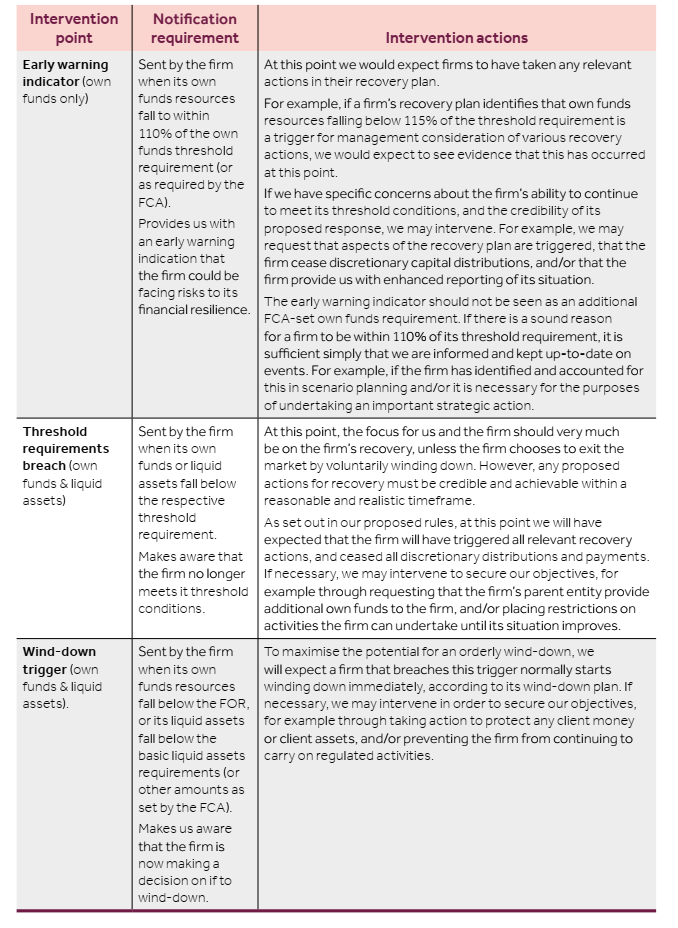
    If a firm’s level of own funds drops below 110% of the requirement then this will trigger an early warning with the FCA. If the firm’s own funds or liquid assets fall below a certain level then the firm would need to wind down.


    Own funds

    Own funds mainly relate to the Equity section of a firm’s balance sheet. Most of our clients will typically have common equity tier 1 capital but we don’t expect many to have significant levels of Additional Tier 1 (eg certain types of preference shares) or Tier 2 capital (eg subordinated debt due after 5 years.

    Common equity tier 1 capital

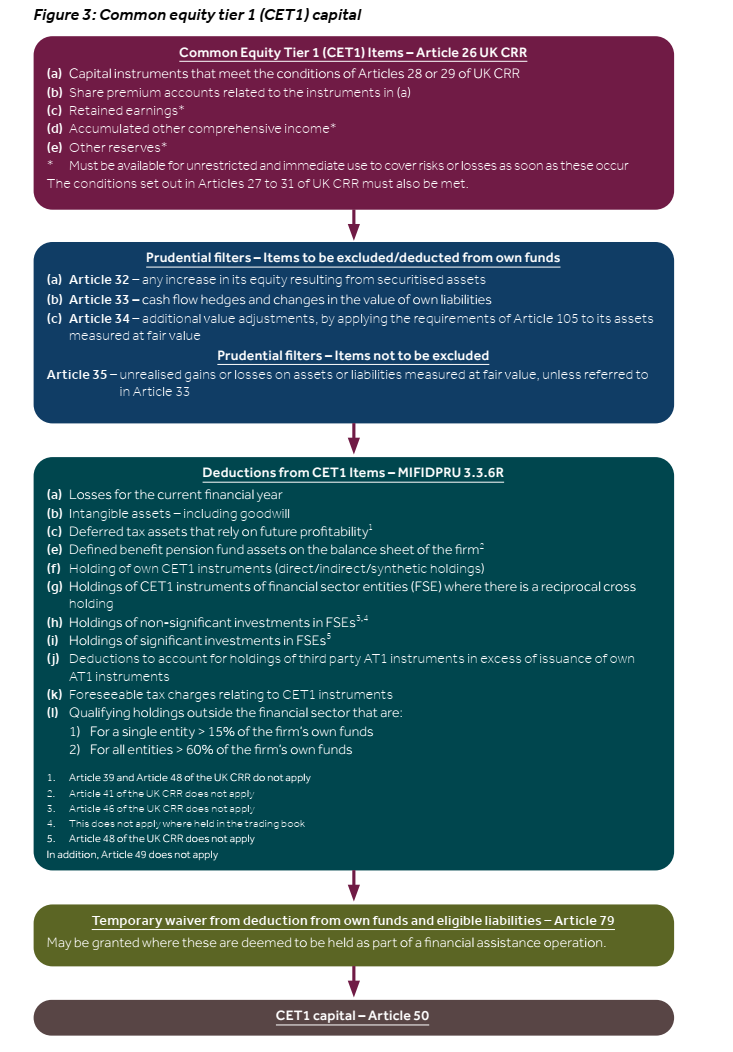
    This is share capital, share premium, retained earnings and other reserves less deductions for losses of the current financial year and certain assets such as intangible assets, deferred tax, pension assets, investments in financial firms and a number of others etc (see FCA handbook MIFIDPRU 3.3.6 for the full list). The FCA’s CP20/24 also has Figure 3:

    It may also be possible to include interim profits and new capital instruments (eg ordinary shares) with permission from the FCA. See FCA handbook MIFIDPRU 3.3.2 and 3.3.3 and for the forms. The FCA handbook mentions they expect to receive a notification at least 20 business days before the issuance.

    The independent auditors would also need to verify the profit and write a letter to confirm the profit figure.


    Own funds requirement

    Firms will have to maintain own funds that at least equal to their own funds requirement. For small investment firms which meet the SNI criteria2 this is the higher of:

    • permanent minimum capital (“PMR”)
    • fixed overheads requirement (“FOR”)

    Permanent minimum capital (“PMR”)

    For most small firms their PMR will be £75,000 if they do not hold client money/securities and are not placing orders on a firm commitment basis. (ie similar to EUR50k firms under old rules)

    If firms hold client money and also cannot operate matched principal trading or dealing on their own account their PMR will be £150,000.

    For other firms their PMR will be £750,000.

    See MIFIDPRU 4.4.1 for full details. There are also transitional arrangements so that the PMR does not need to be held straight away on 1 January 2022. See the FCA Handbook MIFIDPRU TP 2 and also CP20/24 Chapter 6.

    Fixed overheads requirement (“FOR”)

    The FOR is the minimum level a firm would need to absorb losses if it has to wind down or exit the market. Firms will need to consider this in detail in their Internal Capital Adequacy and Risk Assessment (ICARA) process.

    The FOR is calculated as 1/4 of its relevant expenditure in the previous year as per its most recent audited accounts.

    This will exclude fully discretionary expenditure such as as:

    • staff bonuses and variable remuneration
    • non recurring expenses from non-ordinary activities
    • amortisation where intangibles are already deducted from own funds

    See MIFIDPRU 4.5.3 for full details.


    Basic liquid assets requirement

    Firms need to hold in core liquid assets at least 1/3 of their fixed overhead requirement plus 1.6% of the total amount of any guarantees provided to clients.

    Core liquid assets are mainly cash and SNIs can also use short term trade receivables due within 30 days, subject to a 50% haircut (ie like a bad debt provision). The assets also need to be denominated in pound sterling, so this would exclude cash or trade receivables in USD or EUR for example.

    Cash needs to be short term deposits in held at a UK authorised credit institution. Certain money market funds can also be used.

    See MIFIDPRU 6.2.1 onwards.


    Overall financial adequacy rule

    Firms would need to assess various business risks in detail as part of the ICARA process. This is a very complex and wide area, and only covered briefly here.

    A firm needs to hold sufficient own funds and liquid assets for the firm to remain financially viable throughout the economic cycle and to allow it to be wound down in an orderly manner, if needed.

    The amount of own funds needed is the:

    • amount of own funds needed to fund ongoing business and cope with periods of stress; and
    • the amount of own funds needed to allow it to wind down in an orderly manner

    The own funds threshold requirement is the amount of own funds needed to enable a firm to comply with the overal financial adequacy rule.

    FCA Handbook MIFIDPRU 7.6.4 also has this picture:

    The amount of liquid funds needed is the basic liquid assets requirement plus the higher of:

    • an amount of liquid assets needed to fund ongoing business and cope with periods of stress
    • additional amount of liquid assets needed to allow it to wind down in an orderly manner

    It can also include non-core liquid assets in the calculation, see MIFIDPRU 7.7.8.


    Notfying the FCA & Triggers

    Firms must notify the FCA if the liquid assets or own funds fall below certain limits. A wind down would also be triggered if they fall too low.

    CP21/7 has the following table which summarises the rules:

    Early warning indicator and other intervention points

    1Where can we find the rules?

    The easiest place to start is the FCA Handbook MIFIDPRU Prudential Sourcebook for MiFID Investment Firms.

    There are also further explanations in the FCA’s consultation and policy papers on IFPR CP20/24, CP21/7 and PS21/17.

    The FCA Handbook often refers to “UK CRR”. CRR stands for Capital Requirements Regulations and was originally EU legislation. After Brexit the UK has its own version.

    UK CRR is the UK version of Regulation of the European Parliament and the Council on prudential requirements for credit institutions and investment firms (Regulation (EU) No 575/2013) and amending Regulation (EU) No 648/2012, which is part of UK law by virtue of the EUWA, read together with any CRR rules as defined in section 144A of the Act.

    As a starting point, the EU CRR Articles define the types of capital and then the adjustments required can generally be found in the FCA Handbook.

    The actual UK legal instruments are also noted on the FCA’s website about IFPR.


    2SNI firms

    There are a number of conditions, but the main ones are:

    • average assets under management less than £1.2 billion
    • client orders handled are less than £100m per day for cash trades and £1 billion per day for derivatives
    • does not have permission to deal on its own account
    • balance sheet total (including off balance sheet items) less than £100m
    • annual revenue is less than £30m
  • Gift Aid

    If you give money to charity then you can obtain tax relief if you are a higher rate taxpayer and the donation was made to a registered charity in the EU (plus Norway, Iceland and Liechtenstein).

    You can also obtain relief for donations made to Community Amateur Sports Clubs (CASCs) that were registered with HMRC when you  made the donation.

    Paperwork

    You’ll need to make a gift aid declaration to the charity, whether its in writing/electronic/verbal and you should also receive and keep a receipt for the donation.

    Tax relief

    Your basic rate limit will be increased by the donation, grossed up by the basic rate 20%, and this means that you will save tax.

    For example, if you give £1,000 to charity and are a 40% taxpayer, your basic rate will be increased by £1,000 x 100/80 = £1,250. The tax saving is then £1,250 x (40%-20%) = £250

    Carry back to previous tax return

    You can claim gift aid early by including it in your previous tax return upto 31 January.

    For example, you make a donation in October 2021, and you can claim it in the 2010/21 tax return (instead of waiting until the following year for 2021/22 tax return).

    Shares/property

    There are sometimes reliefs available, but you should check the rules