
Author: Himely Hafiz Pushpo

  • Business Entertaining Expenses in the UK: What You Can and Cannot Claim in 2026

    General Rule for Business Entertainment Expenses

    For both corporation tax and income tax purposes, the general rule is that no deduction is allowed for expenses incurred in providing entertainment or gifts in connection with a trade or business.

    This rule applies whether a company pays for the expenses directly or reimburses an employee for costs they have incurred exclusively for providing the entertainment or gift.

    What is “Entertainment”?

    The term “entertainment” is defined broadly and includes hospitality of any kind. For VAT purposes, HMRC provides examples of what this can include:

    • Food and drink
    • Accommodation in hotels
    • Tickets for theatre, concerts, or sporting events
    • Entry to clubs or nightclubs
    • Use of facilities such as yachts or aircraft to entertain

    Expenses incidental to the provision of entertainment are also included in this disallowance.

    Exceptions to the General Rule (Corporation Tax and Income Tax)

    The general prohibition on deducting entertainment and gift expenses is subject to several specific exceptions.

    1. Employee Entertainment

    A deduction is permitted for the cost of providing entertainment for a business’s employees. For these purposes, an “employee” includes a director of the company and any person engaged in its management.

    However, this exception does not apply if:

    • The entertainment is also provided for non-employees (such as clients); and
    • The provision of entertainment for the employees is incidental to its provision for the non-employees.

    In practice, this means that if an event is primarily for entertaining clients and employees are only present as hosts, the cost of entertaining those employees is not deductible. If an event is exclusively for staff, the cost is generally deductible.

    2. Entertainment as Part of a Trade

    A deduction is allowed where the entertainment is of a kind that it is the company’s or trader’s business to provide, and it is provided in the ordinary course of that business. This can be either for payment or free of charge for the purpose of advertising to the public generally. For example, a restaurant offering free samples to the general public to promote its menu would fall under this exception.

    3. Business Gifts

    While gifts are generally not deductible, there are four main exceptions:

    Case A: Gifts as part of a trade: Similar to the entertainment exception, a deduction is allowed if the gift is an item which it is the business’s trade to provide, and it is given away in the ordinary course of that trade to advertise to the public generally.

    Case B: Gifts for advertising: A deduction is allowed for a gift that incorporates a conspicuous advertisement for the business. However, this exception is subject to two conditions:

    1. The gift cannot be food, drink, tobacco, or a token/voucher exchangeable for goods.
    2. The total cost of all such gifts to the same person in the same accounting period (for companies) or tax year (for sole traders) must not exceed E50.

    Case C: Gifts to employees: The cost of gifts provided to employees is deductible, unless the gifts are also provided to others and the provision to employees is incidental to the provision for others.

    Case D: Gifts to charities: A deduction is allowed for gifts made to a charity, the Historic Buildings and Monuments Commission for England, or the Trustees of the National Heritage Memorial Fund.

    VAT Treatment of Business Entertainment

    The rules for reclaiming VAT on entertainment expenses are also restrictive. The Value Added Tax (Input Tax) Order 1992 prevents businesses from recovering input VAT on the provision of business entertainment. For VAT purposes, “business entertainment” means providing free hospitality to persons who are not employees.

    Who is an “employee” for VAT? The definition is specific and includes:

    • Current employees.
    • Directors and partners.
    • Self-employed individuals treated in the same way as employees for subsistence purposes.
    • Temporary staff.
    • Helpers and stewards essential for running an event.

    It does not include former employees, pensioners, job applicants, or shareholders who are not also employees.

    Because the VAT block only applies to non-employees, input VAT incurred on entertaining a business’s own employees is generally recoverable. However, if employees act as hosts for non-employees, none of the input VAT can be claimed.

    Exception for Overseas Customers The block on recovering input VAT does not apply to the entertainment of overseas customers. An “overseas customer” is one not ordinarily resident or carrying on a business in the UK. However, even if the input VAT is recovered, an output tax charge may be due if there is a “private benefit” to the individual being entertained. This charge can cancel out the benefit of the recovered input tax.

    A private benefit charge will not apply where the expenditure is necessary and for strict business purposes. For example:

    • Providing basic refreshments like sandwiches and soft drinks during an office meeting to avoid interruption is considered to have a strict business purpose.
    • Taking a customer to a restaurant, providing alcohol, or offering general corporate hospitality (like a golf day) is likely to result in a private benefit and a corresponding output tax charge.

    Record Keeping

    HMRC considers good record-keeping essential, as it underpins accurate tax returns. Research shows that poor record-keeping is a key factor in many incorrect returns, and penalties may be applied for non-compliance.

    A “document” is defined broadly as ‘anything in which information of any description is recorded’. This includes both paper documents and electronic records stored on devices like hard drives, memory sticks, or smartphones. Businesses must ensure they maintain adequate records to support any claims for deductions.

    Summary: What Can and Cannot Be Claimed

    CategoryExamples of Allowable CostsExamples of Disallowed Costs
    Clients/SuppliersGifts for advertising with a conspicuous logo costing E50 or less per person per year (not food, drink, tobacco, or vouchers).Free samples provided to the public generally as part of the ordinary course of trade.Meals, drinks, event tickets, hotel stays, or any other form of hospitality. Gifts costing more than £50, or gifts of food, drink, or tobacco.
    EmployeesCosts of staff parties, team- building events, and other functions for employees only.Costs of entertaining employees where it is incidental to the entertainment of clients or other non-employees.
    Mixed Events (Employees & Clients)The employee portion may be deductible only if it is not incidental to entertaining the clients. This is a high bar to meet.The entire cost is likely to be disallowed, as the employee element will be seen as incidental to client hospitality.

    Cited sources

    1. https://www.gov.uk/hmrc-internal-manuals/compliance-handbook/ch214000
    2. https://www.gov.uk/hmrc-internal-manuals/compliance-handbook/ch211000
    3. https://www.gov.uk/hmrc-internal-manuals/vat-input-tax/vit43200

    Additional relevant sources

    1. https://www.legislation.gov.uk/ukpga/2009/4/part/20/chapter/1/crossheading/business-entertainment-and-gifts
    2. https://www.legislation.gov.uk/ukpga/2005/5/section/45
    3. https://www.gov.uk/hmrc-internal-manuals/cotax-manual/com100
    4. https://www.gov.uk/hmrc-internal-manuals/compliance-handbook/ch205200
    5. https://www.gov.uk/hmrc-internal-manuals/compliance-handbook/ch202025

  • Optimizing Liquidity: Using Short Term Money Market Funds for MIFIDPRU 6

    Optimizing Liquidity: Using Short Term Money Market Funds for MIFIDPRU 6

    Requirements

    For investment firms regulated under the FCA’s Prudential sourcebook for MiFID Investment Firms (MIFIDPRU), managing liquidity is a critical and constant obligation. The regime mandates that firms hold a sufficient buffer of high-quality liquid assets to ensure they can withstand a period of financial stress. While holding cash is the most straightforward way to meet these requirements, it can be inefficient, offering little to no return on significant capital balances.

    A strategic alternative is the use of Short Term Money Market Funds (MMFs). When selected carefully, certain MMFs can offer a yield on regulatory capital while fully satisfying the stringent liquidity rules. This article provides a technical overview of how MIFIDPRU firms can use MMFs to meet their Basic Liquid Assets Requirement.


    The Basic Liquid Assets Requirement under MIFIDPRU 6

    The core of the liquidity framework is found in MIFIDPRU 6. It requires a MIFIDPRU investment firm to hold, at all times, an amount of “core liquid assets” that is at least equal to one-third of its Fixed Overheads Requirement (FOR). For firms providing certain guarantees to clients, an additional 1.6% of the total value of those guarantees must also be held in liquid assets. This is known as the Basic Liquid Assets Requirement.

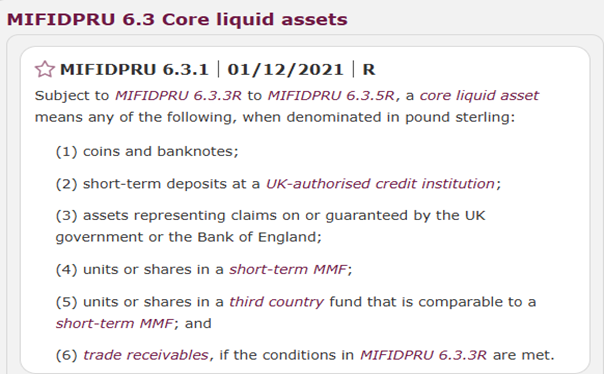
    The definition of “core liquid assets” is highly prescriptive. According to rule MIFIDPRU 6.3.1, these assets are strictly limited to:

    FCA liquidity Requirements for EFTS and short term MMFS

    While all categories are important, the use of MMFs warrants particular attention due to the potential for enhanced yield combined with regulatory compliance.


    What Constitutes a “Short-Term Regulated Money Market Fund”?

    The most critical aspect for firms to understand is that “short-term regulated money market fund” is a specific regulatory designation, not a general marketing term. For a fund to be eligible as a core liquid asset, it must be formally authorized as a “Short-Term Money Market Fund” under the UK Money Market Funds Regulation (UK MMF Regulation).

    This regulation imposes stringent requirements on the fund’s structure and portfolio, designed to ensure high levels of liquidity and low risk. Key criteria include:

    • Portfolio Composition: The fund must invest in a portfolio of high-quality, short-term assets such as government securities, certificates of deposit, commercial paper, and repurchase agreements (repos).
    • Maturity Limits: The fund must adhere to strict maturity limits for its portfolio, including a Weighted Average Maturity (WAM) of no more than 60 days and a Weighted Average Life (WAL) of no more than 120 days.
    • Credit Quality: The fund is restricted to investing in instruments of high credit quality, subject to a formal internal credit assessment process.
    • Diversification: The regulation mandates strict diversification rules to mitigate concentration risk to any single issuer or counterparty.

    Funds that do not meet these criteria, even if they are marketed as “cash-like” or “money market” funds, will not qualify as core liquid assets.

    Practical Application: Distinguishing Eligible from Ineligible Funds

    The distinction between qualifying and non-qualifying funds is best illustrated with practical examples.

    • Potentially Eligible Fund: A fund structured as a UCITS ETF that explicitly states its objective is to provide returns in line with money market rates by investing directly in a portfolio of high-quality, short-term debt instruments, deposits, and repos. Such a fund is designed to operate within the constraints of the UK MMF Regulation and is a strong candidate for eligibility.
    • Ineligible Fund: A synthetic ETF that aims to replicate an overnight interest rate using financial derivatives, such as swaps. This type of fund does not hold a portfolio of underlying cash or debt instruments. Due to its synthetic nature and the inherent counterparty risk associated with swaps, it cannot meet the strict portfolio composition and credit quality criteria required for authorization as a Short-Term MMF under the UK MMF Regulation. Therefore, it would be ineligible as a core liquid asset.

    Due Diligence: The Non-Negotiable Step

    Before a firm includes any MMF in its liquidity calculation, it must perform thorough due diligence. This involves obtaining and scrutinizing the fund’s official documentation, specifically the Key Investor Information Document (KIID) and the full prospectus.

    These documents must contain an explicit statement confirming that the fund is authorized as a “Short-Term Money Market Fund” under the UK MMF Regulation. Without this confirmation, the investment cannot be treated as a core liquid asset.

    Regulatory Treatment: Haircuts and Reporting

    The regulatory treatment for qualifying MMFs is highly favorable. Under MIFIDPRU 7, units in a qualifying short-term regulated money market fund are subject to a 0% haircut. This means they can be valued at 100% of their current market value for the purpose of the Basic Liquid Assets Requirement calculation, effectively treating them as equivalent to a cash deposit.

    Conversely, if an asset does not meet the strict definition of a core liquid asset, it is not a matter of applying a higher haircut. The asset is simply ineligible and cannot be included in the calculation at all. Attempting to include a non-qualifying fund, such as a synthetic ETF, would result in a breach of the firm’s liquidity requirements.

    Conclusion

    For MIFIDPRU investment firms, utilizing Short-Term Money Market Funds can be a prudent and effective strategy for managing regulatory liquidity. It allows firms to move beyond the zero-return environment of cash holdings and earn a yield on their mandatory liquid asset buffer.

    However, this strategy is contingent on rigorous due diligence. Firms must look beyond marketing descriptions and verify the precise regulatory status of any fund under the UK MMF Regulation. By ensuring that investments strictly qualify, firms can confidently optimize their liquidity management, enhance capital efficiency, and remain fully compliant with their prudential obligations.

  • FRS 102 Lease Accounting Changes 2026: Complete Guide for Lessees

    FRS 102 Lease Accounting Changes 2026: Complete Guide for Lessees

    FRS 102 Section 20 Leases undergoes major updates from the 2024 Periodic Review, effective 1 January 2026, requiring UK and Irish entities to recognize most leases on the balance sheet as right-of-use (ROU) assets and lease liabilities, aligning with IFRS 16 principles. This shift ends the operating vs. finance lease split for lessees, increasing reported assets and liabilities while front-loading expenses via depreciation and interest essential knowledge for accountants, SMEs, and financial directors preparing financial statements. What does FRS 102 lease accounting mean for your business in 2026? Read on for step-by-step compliance.

    What Are the Key FRS 102 Lease Accounting Changes for 2026?

    Revised Section 20 mandates on-balance-sheet treatment for lessees, capturing nearly all leases unlike prior rules that kept operating leases off-balance-sheet. Expect higher assets (ROU) and liabilities (future payments discounted), impacting ratios like gearing and EBITDA preparers must review contracts early to avoid surprises. Lessors retain the finance/operating distinction, but lessees face uniform recognition; applies to all FRS 102 users, including Section 1A small entities.

    • Effective Date: Annual periods beginning on or after 1 January 2026; early adoption allowed with full Periodic Review changes.
    • Transition: Retrospective with cumulative effect in opening equity; no restatement of comparatives.
    • Tax Implications: HMRC may allow spreading of adjustment debits/credits over years.

    Recognition Exemptions: Short-Term and Low-Value Leases

    Lessees can elect exemptions to skip balance sheet recognition for simplicity answer: yes, but only for specific cases, applied consistently by asset class.

    Exemption TypeCriteriaAccounting TreatmentKey Notes
    Short-Term Leases≤12 months from commencement, no purchase option Straight-line expense (like old operating leases)Includes rent-free periods; reassess term for options 
    Low-Value AssetsAbsolute low value (e.g., tablets, phones, small furniture; excludes property, cars) Straight-line expense, lease-by-leaseNo subleasing; asset must stand alone, not broken into parts 

    Disclosures still apply to exempted leases; portfolio approach permitted for similar leases.

    How to Identify a Lease Under FRS 102 (2026 Rules)

    A lease exists when a contract conveys the right to control an identified asset for a period in exchange for consideration control means directing use and capturing economic benefits. Common question: Is my service contract a lease? Check for explicit/implicit asset specification without supplier substitution rights.

    • Identified Asset: Named (e.g., specific vehicle) or implicit (e.g., delivered rail stock); no substantive substitution (practical + economic benefit to supplier).
    • Portions: Physically distinct (e.g., building floor) qualifies; capacity shares only if substantially all.
    • Separate Components: Allocate by standalone prices (lease vs. maintenance); optional expedient combines by asset class.
    • Intra-Group Tip: Enforceability matters-no contract, no lease.

    Example: Leasing two lorries with services? Split CU32k total: CU11.2k each lorry, CU9.6k non-lease.

    Determining Lease Term: Extensions, Breaks, and Rolling Leases

    Lease term = non-cancellable period + reasonably certain extensions – reasonably certain non-exercises of terminations. Factors: asset importance, fit-outs, past practice, economics.

    • Reassessment Triggers: Lessee-controlled changes (e.g., new info on options).
    • Rolling Leases: Assess enforceability/penalties for non-cancellability; may qualify as short-term.
    • LTA 1954: Statutory renewals impact post-expiry occupation.

    Example: 10-year lease + 5-year extension option? If fit-outs and history suggest certainty, term = 15 years.

    Lease Liability Measurement: Step-by-Step Calculation

    Step 1: Identify payments fixed/in-substance fixed, index/rate variables (at commencement), residuals, certain purchases/penalties.

    Step 2: Discount using implicit rate (if known), else incremental borrowing rate (funds for similar asset/term/security) or obtainable rate (undiscounted payments). Portfolio OK for similars.

    Example (5-year CU10k p.a. arrears, 7% rate): PV = CU41,002 liability. Unwinds with interest (total expense = cash).

    Remeasurements:

    • Term/purchase: Revised rate.
    • Index change: Unchanged rate (when effective).
    • Modifications: Separate if scope/consideration proportional; else revise ROU proportionately.

    Right-of-Use Asset: Initial and Ongoing Measurement

    ROU = liability + prepayments – incentives + initial costs + dismantlings/grants, then depreciate (cost model standard; revaluation/investment property options). Adjust for liability remeasurements (min zero).

    FAQ: Common FRS 102 2026 Lease Questions

    Does FRS 102 2026 affect tax? Balance sheet changes may trigger spreading relief.
    Impact on covenants? Higher liabilities strain ratios—model now.
    Software needed? Yes for PV calcs (PV/NPV/XNPV functions).
    Small entities? Full compliance under 1A.

    Next Steps for FRS 102 Compliance in 2026

    1. Inventory contracts (including non-legal leases).
    2. Collect data: terms, rates, options.
    3. Test exemptions and portfolios.
    4. Update policies/systems; train staff.
    5. Engage advisors for transitions/tax.

    Stay compliant FRS 102 changes reshape reporting.
    For tailored advice, consult MAH Chartered Accountants.

  • Tax Planning for Property Owners: Mid-Year Updates and Strategy for 2025

    Tax Planning for Property Owners: Mid-Year Updates and Strategy for 2025

    Tax Planning for Property Owners UK 2025

    As we reach the midpoint of 2025, UK property owners face a complex tax environment shaped by reduced allowances, evolving rates, and important legislative freezes. Mid-year is an ideal time to review your tax strategy, optimize your position, and prepare for changes ahead. This article outlines key updates and practical strategies tailored for UK property owners in 2025.

    1. Capital Gains Tax (CGT) Planning: Navigating Lower Allowances and Higher Rates

    One of the most significant changes for property owners in 2025 is the reduction of the CGT annual exempt amount to just £3,000, down from £6,000 in 2023/24 and £12,300 in 2022. This means more gains from property disposals will be taxable, increasing the importance of careful planning.

    Key CGT rates for 2025:

    • Residential property: 24% for basic and higher-rate taxpayers, 28% for additional-rate taxpayers.
    • Non-residential property: 18% for basic-rate taxpayers, 24% for higher/additional-rate taxpayers (rates increased from 30 October 2024).

    Mid-Year CGT Strategies:

    • Timing disposals: Spread sales across tax years to fully utilise the £3,000 exemption annually.
    • Use capital losses: Offset gains with any realised losses to reduce taxable amounts.
    • Consider reliefs: Private Residence Relief and Lettings Relief may reduce CGT if the property was your main home or partially occupied.
    • Gifting assets: Transferring property to a spouse or into trusts can be effective but requires professional advice.

    2. Stamp Duty Land Tax (SDLT) Changes: Act Before April 2025

    From April 1, 2025, the temporary higher SDLT thresholds introduced during the pandemic will end, and the surcharge on second homes will rise from 3% to 5%. This change will increase the upfront tax cost on property purchases, especially for buy-to-let investors and second-home buyers.

    Mid-Year Action Points:

    • Complete planned property purchases before April 2025 to benefit from lower SDLT rates.
    • Factor the increased SDLT surcharge into your investment calculations for acquisitions after April.
    • Review your property portfolio to assess potential SDLT liabilities on future transactions.

    3. Income Tax and Rental Property: Maximising Allowable Deductions

    Rental income remains taxable under UK income tax rules, with landlords required to declare profits after allowable expenses.

    Key considerations for 2025:

    • Mortgage interest relief: Full relief is available only for properties held in companies; individual landlords face restrictions but can claim a tax credit.
    • Allowable expenses: Repairs, letting agent fees, insurance, and maintenance costs reduce taxable income.
    • Incorporation: For higher-rate taxpayers, transferring properties into a limited company may reduce tax liabilities due to lower corporation tax rates (25% for profits over £250,000).

    4. Inheritance Tax (IHT) Planning: Use Current Nil-Rate Bands Before Freezes

    The nil-rate band remains at £325,000, with the residence nil-rate band up to £175,000, effectively allowing a combined allowance of £500,000 per person. However, these thresholds are frozen until 2030, and from April 2026, reliefs on agricultural and business property will be capped at £1 million.

    Mid-Year IHT Strategies:

    • Make use of annual gift exemptions (£3,000 per year) and small gifts (£250 per person).
    • Consider setting up trusts to remove assets from your estate and reduce future IHT exposure.
    • Plan gifts and transfers now to start the seven-year clock, maximising tax efficiency before relief caps take effect.

    5. Pension Contributions and Other Tax-Efficient Investments

    Maximising pension contributions remains a powerful way to reduce taxable income in 2025. Contributions up to £60,000 per year receive tax relief, subject to earnings and tapering rules.

    Other tax-efficient options include:

    • ISAs: Up to £20,000 tax-free savings allowance.
    • Gift Aid donations: Reduce taxable income while supporting charities.
    • Enterprise Investment Schemes (EIS) and Venture Capital Trusts (VCTs): Offer income tax relief and CGT exemptions.

    6. Compliance and Professional Advice: Stay Ahead

    Tax rules for property owners continue to evolve, with increased scrutiny on compliance and reporting requirements, especially for corporate property holdings (e.g., Annual Tax on Enveloped Dwellings – ATED).

    Recommendations:

    • Conduct a mid-year tax review with your accountant or tax advisor.
    • Adjust estimated tax payments to avoid penalties.
    • Keep detailed records of income, expenses, and transactions.
    • Stay informed about potential legislative changes affecting property tax.

    Conclusion

    For UK property owners, 2025 demands vigilant mid-year tax planning to navigate lower CGT allowances, SDLT changes, and frozen IHT thresholds. By timing disposals, maximising reliefs, considering incorporation, and leveraging tax-efficient investments, you can optimise your tax position and protect your wealth.

    Engage with professional advisors now to tailor strategies to your circumstances and ensure compliance with the latest tax rules.

    This article is based on current UK tax legislation and guidance available as of mid-2025 and is intended for informational purposes only. Consult a qualified tax professional for personalized advice.

  • Is Your Pension Plan Tax-Efficient? July Review Tips for 2025

    Tax-efficient pension plan review 2025

    Is Your Pension Plan Tax-Efficient? July Review Tips for 2025 (UK)

    As we reach July 2025, reviewing your pension plan for tax efficiency is more important than ever. With evolving UK pension rules, frozen tax thresholds, and new policy reforms, a mid-year check can help you maximise your retirement savings and minimise unnecessary tax liabilities. Here’s how to ensure your pension plan is working as hard as possible for you this year.

    1. Maximise Your Annual Allowance

    • For 2025/26, most UK residents can contribute up to £60,000 per year into pensions and receive tax relief, though this is capped at your annual earnings if lower.
    • High earners (adjusted income over £260,000) face a tapered annual allowance that can reduce the limit to as low as £10,000.
    • If you haven’t used your full allowance in the past three years, you can carry forward unused amounts, provided you were a member of a UK-registered pension scheme during those years.

    2. Use Salary Sacrifice and Employer Contributions

    • Salary sacrifice arrangements allow you to exchange part of your salary for pension contributions, reducing your taxable income and National Insurance contributions.
    • Always check if your employer offers matching contributions—this is essentially free money towards your retirement.

    3. Review Your Drawdown Strategy

    • When you access your pension, you can usually take 25% tax-free; the rest is taxed as income.
    • Plan withdrawals to avoid moving into a higher tax band. Taking smaller, regular amounts can help you stay in a lower tax bracket.
    • If you start flexible withdrawals, the Money Purchase Annual Allowance (MPAA) applies, reducing your future tax-relieved contributions to £10,000 per year.

    4. Stay Informed on Policy Changes

    • The Pension Schemes Bill 2025 introduces reforms aimed at consolidating small pension pots, improving value for money, and streamlining the transfer process.
    • The government’s Pensions Investment Review focuses on boosting returns for savers and encouraging pension funds to invest in UK assets.

    5. Consider Inheritance Tax and Estate Planning

    • Future changes may affect how pensions are treated for inheritance tax. Review your estate plan and consider using trusts or making gifts within your annual allowance to reduce your taxable estate.

    6. Regularly Review and Rebalance Investments

    • Check if your pension investments still align with your goals and risk appetite. Rebalancing annually can help you stay on track and take advantage of market opportunities.
    • Use online tools or consult with a financial adviser for tailored advice.

    7. Don’t Overlook Tax Relief

    • Basic-rate taxpayers receive 20% tax relief on contributions, while higher and additional-rate taxpayers can claim extra relief via self-assessment.
    • Ensure you’re not missing out on valuable tax benefits, especially if you’re a higher earner or have multiple pension pots.

    Key 2025/26 UK Pension Allowances

    Allowance Type2025/26 LimitNotes
    Annual Allowance£60,000Reduced for high earners (tapered to £10,000)
    Money Purchase Annual Allow.£10,000Applies after flexible withdrawals
    Tax-Free Lump Sum25% of potUp to £268,275
    Carry Forward (unused)Up to 3 yearsMust have been scheme member

    Final Thoughts

    A tax-efficient pension plan review in July 2025 is essential for UK savers. By maximizing contributions, leveraging salary sacrifice, planning withdrawals, and staying up to date with policy changes, you can boost your retirement savings and reduce your tax burden. Regular reviews and professional advice will help you adapt to new rules and secure your long-term financial future.

  • How to Minimize Your Capital Gains Tax Liability in the UK for 2025 and 2026

    Latest Capital Gains Tax Updates 2025 UK

    Capital Gains Tax (CGT) in the UK has undergone significant changes effective from late 2024 and into the 2025 and 2026 tax years. The Latest Capital Gains Tax Updates 2025 UK include increased rates, reduced allowances, and new relief provisions that impact how much tax you pay on gains from asset disposals. These updates affect the rates, allowances, and reliefs available, making it essential for taxpayers to understand how to manage and minimize their CGT liabilities effectively.

    Latest CGT Updates for 2025 and 2026

    New CGT Rates and Allowances

    • From 6 April 2025 onwards, the main CGT rates for individuals (excluding carried interest gains) are:
      • 18% for gains within the basic income tax band.
      • 24% for gains above the basic income tax band.
    • Carried interest gains (commonly for investment fund managers) are taxed at 32%.
    • Trustees and personal representatives generally pay 24%, or 32% on carried interest gains.
    • Business Asset Disposal Relief (BADR) and Investors’ Relief rates increase to 14% from April 6, 2025, and further to 18% from April 6, 2026.
    • The annual exempt amount (AEA) for individuals is reduced to £3,000 for 2025/26 (down from £6,000 in 2024/25), and £1,500 for trusts.

    Transitional and Anti-Forestalling Measures

    • The CGT rates increased from 10%/20% to 18%/24% for disposals after October 30, 2024.
    • Anti-forestalling rules are in place to prevent taxpayers from structuring transactions to avoid the higher rates.
    • Elections related to rollover relief and share reorganizations must be made by April 5, 2025, for disposals between April 6, 2023, and April 5, 2025.

    Impact on Taxpayers

    • The reduced allowance and higher rates mean more gains will be taxable.
    • The Office for Budget Responsibility estimates CGT receipts of £19.7 billion in 2025-26, reflecting these changes.

    How to Minimize Your Capital Gains Tax Liability in 2025 and 2026

    1. Maximize Use of the Annual Exempt Amount

    • Utilize the £3,000 CGT allowance fully each year.
    • Couples can transfer assets between spouses or civil partners tax-free to double the allowance to £6,000.

    2. Plan Timing of Asset Disposals

    • Spread disposals over multiple tax years to benefit from multiple annual exemptions.
    • Consider timing sales to years when your income is lower, potentially reducing your CGT rate.

    3. Use Tax-Efficient Wrappers

    • Invest through ISAs and pensions where gains are exempt from CGT.
    • Consider transferring assets into these accounts where possible.

    4. Offset Gains with Losses

    • Claim allowable capital losses to offset gains in the same or future tax years, reducing taxable gains.

    5. Take Advantage of Business Asset Disposal Relief

    • For qualifying business disposals, BADR reduces CGT to 14% in 2025/26, rising to 18% in 2026.
    • Plan disposals to meet BADR criteria before the rate increases fully apply.

    6. Use Spousal Transfers Strategically

    • Transfers between spouses or civil partners are exempt from CGT.
    • This allows for income and gains to be split, potentially reducing tax rates and doubling allowances.

    7. Consider Investment in EIS/SEIS Schemes

    • These schemes offer CGT deferral or exemption on qualifying investments.
    • Suitable for those with significant gains seeking tax-efficient investment opportunities.

    8. Beware of Anti-Forestalling Rules

    • Avoid transactions designed solely to circumvent higher CGT rates.
    • Ensure elections for rollover relief and other provisions are made timely.

    Example of CGT Calculation for 2025/26

    • Taxable income: £20,000
    • Taxable gains: £12,600
    • Deduct annual exempt amount (£3,000), taxable gain = £9,600
    • Combined income and gain = £29,600 (within basic rate band of £37,700)
    • CGT payable at 18% = £1,728

    For larger gains exceeding the basic rate band, gains above £37,700 are taxed at 24%.

    Summary Table of Key CGT Rates (from 6 April 2025)

    Asset TypeBasic Rate TaxpayerHigher Rate TaxpayerSpecial Rates
    Most chargeable assets18%24%
    Residential property gains18%24%
    Carried interest gains32% (all taxpayers)32% (all taxpayers)
    Business Asset Disposal Relief14% (2025/26)14%18% from April 2026
    Annual exempt amount (individuals)£3,000£3,000

    Conclusion

    The CGT landscape for 2025 and 2026 in the UK demands careful planning due to reduced allowances and increased rates. By understanding the new rules and employing strategies such as maximizing exemptions, timing disposals, using tax-efficient accounts, and leveraging reliefs like BADR, taxpayers can effectively minimize their CGT liability.

    For complex situations or significant gains, you should seek professional tax advice to navigate the evolving CGT environment and to ensure compliance while optimizing tax outcomes.

  • Is Your Business Fully HMRC Compliant?

    Ensuring full compliance with HM Revenue and Customs (HMRC) is a fundamental responsibility for every UK business. Failure to meet HMRC’s standards can result in penalties, legal action, and reputational damage. In 2025, new regulatory changes and increased scrutiny mean that business owners must be more vigilant than ever. Here’s what you need to know to keep your business fully HMRC compliant.

    HMRC compliance for businesses

    What Does HMRC Compliance Mean?

    HMRC compliance means your business is meeting all legal obligations related to tax, payroll, VAT, record-keeping, and reporting. This includes registering with HMRC, paying the right taxes on time, adhering to employment laws, and maintaining transparent records.

    Key Areas of HMRC Compliance

    1. Registration and Accurate Record-Keeping

    • Register your business with HMRC for Corporation Tax, VAT (if your turnover exceeds £85,000), and PAYE if you employ staff.
    • Keep detailed records of all financial transactions, payroll, sales, purchases, and expenses. These records should be organized and readily available for inspection.

    2. Payroll and Employment Law

    • Use HMRC-recognized payroll software to calculate and report PAYE tax and National Insurance contributions.
    • Issue pay slips and ensure compliance with minimum wage and statutory leave laws.
    • Provide employment contracts outlining entitlements and adhere to statutory pay thresholds.

    3. Tax Filing and Payments

    • Submit accurate tax returns (corporation tax, VAT, self-assessment) on time to avoid penalties.
    • Pay all taxes and duties by HMRC deadlines.
    • Maintain copies of recent tax filings and payment receipts as evidence.

    4. VAT Obligations

    • Register for VAT if your annual turnover meets or exceeds the threshold.
    • Submit quarterly VAT returns and maintain proper VAT records and invoices.

    5. Compliance Checks and Audits

    • HMRC may conduct compliance checks or audits, reviewing your tax returns, PAYE records, and VAT accounts.
    • Be prepared by keeping all documentation up-to-date and responding promptly to HMRC inquiries.

    6. Governance and Transparency

    • Maintain open communication with HMRC and your tax agents.
    • For larger businesses, follow HMRC’s “co-operative compliance” framework, emphasizing transparency in tax planning and governance.

    7. Keeping Up with Regulatory Changes

    • 2025 brings new requirements, including identity verification for company directors and changes from the Economic Crime and Corporate Transparency Act.
    • Stay informed by subscribing to HMRC newsletters and consulting with tax advisors to keep up with evolving regulations.

    What Happens If You’re Not Compliant?

    Non-compliance can lead to:

    • Fines and interest on unpaid taxes
    • Legal action, including possible business closure
    • Increased scrutiny and more frequent audits from HMRC

    How Can You Ensure Compliance?

    • Conduct Regular Internal Audits: Review your tax, payroll, and VAT processes to identify and fix any gaps before HMRC does.
    • Use Professional Services: Engage accountants or compliance specialists to help navigate complex requirements.
    • Stay Organized: Keep all records, contracts, and receipts filed and accessible.
    • Monitor Regulatory Updates: Regulatory changes, such as those introduced by the Economic Crime and Corporate Transparency Act, may affect your obligations in 2025 and beyond.

    Final Checklist for HMRC Compliance

    •  Registered with HMRC for all applicable taxes
    •  Accurate and up-to-date financial records
    •  Payroll and PAYE processed using HMRC-recognized software
    •  VAT registration and quarterly returns (if applicable)
    •  Timely tax filings and payments
    •  Employment contracts and statutory benefits in place
    •  Ready for compliance checks or audits

    Conclusion

    Increased HMRC scrutiny and ongoing legislative changes mean that compliance is not a one-time task, but an ongoing process. By staying informed, maintaining robust records, and proactively reviewing your processes, you can ensure your business remains fully HMRC compliant, and avoid the costly consequences of falling short.

  • Tax Planning for High-Income Earners in the UK: Navigating New Rates in 2025

    Tax Planning for High-Income Earners UK 2025

    Understanding the 2025 Tax Environment for High Earners

    High earners in the UK pay tax under a progressive system with several important thresholds:

    • Personal Allowance Withdrawal: For incomes between £100,000 and £125,140, the personal allowance (£12,570) is reduced by £1 for every £2 earned. As a result, this creates an effective marginal tax rate of 60% in this income band.
    • Higher and Additional Rate Bands: Income between £43,662 and £125,140 is taxed at 40%. Income above £125,140 is taxed at 45% (or 39.35% in Scotland).
    • Dividend Income: Dividend tax rates remain at 8.75% (basic), 33.75% (higher), and 39.35% (additional). Note that the dividend allowance has been reduced to £500 from April 2024.
    • Capital Gains Tax (CGT): The annual exempt amount has been lowered to £3,000. This means more asset disposals will be subject to CGT.
    • Child Benefit Claw back: For adjusted net incomes between £60,000 and £80,000, the High Income Child Benefit Charge reduces child benefit payments. This increases marginal tax rates in this range.

    Core Tax Planning Strategies for High-Income Earners

    1. Maximise Pension Contributions

    Pension contributions remain one of the most effective ways to reduce taxable income. You can contribute up to £60,000 per year and receive tax relief. However, this allowance tapers for incomes above £260,000. Therefore, making pension contributions before 5 April 2026 can lower your taxable income. This may restore your personal allowance and reduce your effective tax rate.

    2. Utilise Individual Savings Accounts (ISAs)

    ISAs offer tax-free growth on investments up to £20,000 annually. This shelters interest, dividends, and capital gains from tax. Additionally, Innovative Finance ISAs (IFISAs) provide more tax-efficient investment options. These are ideal for high earners seeking diversification.

    3. Manage Income Timing and Splitting

    Deferring income or spreading it between spouses or civil partners with lower incomes can reduce exposure to higher tax bands. Moreover, salary sacrifice schemes for benefits such as childcare vouchers or extra pension contributions can lower your adjusted net income. This helps to mitigate child benefit claw backs and personal allowance tapering.

    4. Charitable Giving via Gift Aid

    Donations made under Gift Aid increase the value of your charitable contributions. They also reduce your taxable income. Higher and additional-rate taxpayers can claim further tax relief through self-assessment. Thus, philanthropy becomes a tax-efficient strategy.

    5. Capital Gains Tax Planning

    With the CGT exemption reduced to £3,000, timing asset disposals is critical. Selling assets before 5 April 2025 allows you to use the current exemption. Furthermore, you may qualify for Business Asset Disposal Relief (BADR) at a 10% rate if you sell eligible business assets.

    Additional Considerations

    • Child Benefit Charge: High earners should monitor adjusted net income closely. This helps to avoid or minimize the claw back of child benefit payments.
    • Dividend vs. Bonus Payments: For director-shareholders, it may be more tax-efficient to receive bonuses rather than dividends in some cases. This depends on the tax year and applicable rates.
    • Inheritance Tax Planning: With thresholds frozen until 2030 and changes to reliefs coming in 2026, early planning is vital. Using gifts, trusts, and nil-rate bands can reduce future estate tax liabilities.

    Conclusion

    For UK high-income earners in 2025, navigating the complex tax system requires proactive strategies. Maximizing pension contributions, utilizing ISAs, managing income timing, and charitable giving are key tools. These help reduce tax liabilities and protect wealth. Given the complexities of tapering allowances, claw backs, and changing thresholds, seeking specialist advice is highly recommended. This will optimize tax efficiency while ensuring compliance.

  • Preparing for HMRC’s July 31 Payment on Account Deadline: Tax Years 2025 and 2026

    HMRC July 31 Payment on Account

    Who Needs to Pay?

    For the 2025/26 tax year, individuals registered for Self Assessment—typically the self-employed or those with significant untaxed income—must make payments on account if their previous year’s tax bill exceeded £1,000 and less than 80% of their tax was collected at source (such as via PAYE). Notably, from April 6, 2025, the threshold for mandatory Self Assessment tax returns rises to £3,000, exempting many with modest additional incomes.

    What Are Payments on Account?

    Payments on account are advance payments towards your income tax and Class 4 National Insurance for the current tax year. There are two instalments each year:

    • First payment on account: Due by January 31 (alongside any balancing payment for the previous tax year).
    • Second payment on account: Due by July 31.

    Each payment is typically 50% of your previous year’s tax bill (excluding student loan repayments and capital gains tax).

    Example Calculation for 2025/26

    Suppose your tax bill for 2024/25 is £2,000. For the 2025/26 tax year, you will make:

    • £1,000 by January 31, 2026 (first payment on account)
    • £1,000 by July 31, 2026 (second payment on account)

    If your actual 2025/26 tax bill is higher than £2,000, you’ll pay the difference (the “balancing payment”) by January 31, 2027.

    Key Deadlines for 2025 and 2026

    Payment TypeDue DateAmount
    First Payment on Account31 January 202650% of previous year’s tax bill
    Second Payment on Account31 July 202650% of previous year’s tax bill
    Balancing Payment (if needed)31 January 2027Any remaining tax owed for 2025/26

    How to Pay

    You can pay your Self Assessment tax bill via:

    • Online banking or the HMRC app
    • Debit or corporate credit card online
    • Bank or building society (with a paying-in slip)
    • Bacs, Direct Debit, or cheque (allow extra time for processing)

    If the deadline falls on a weekend or bank holiday, ensure your payment arrives by the last working day before, unless using Faster Payments or a debit/credit card.

    What If You Can’t Pay?

    While HMRC does not charge penalties for late payments on account, interest will accrue on any overdue amount. From April 6, 2025, HMRC’s official rate of interest increases to 3.75% per annum, and this rate is subject to quarterly review. If you’re struggling to pay, contact HMRC promptly to discuss payment options or arrange installments.

    Can You Reduce Your Payment?

    If you expect your income for 2025/26 to be lower than the previous year, you may apply to reduce your payments on account. However, if you reduce them too much and underpay, you’ll be charged interest on the shortfall.

    Key Changes for 2025/26

    • Self Assessment threshold: Now £3,000, exempting more low-income individuals from filing.
    • Mandatory reporting: New businesses or those ceasing must report exact commencement/cessation dates in their tax returns.
    • Personal allowance and tax bands: The personal allowance remains at £12,570, with unchanged tax bands for 2025/26.

    Essential Tips for July 31

    • Review your Self Assessment statement or online account for the amount due.
    • Plan your finances to meet deadlines and avoid interest charges.
    • Consider whether you can legitimately reduce your payment on account if your circumstances have changed.
    • Contact HMRC early if you anticipate difficulty paying on time.

    By staying informed and preparing in advance, you can manage your tax obligations efficiently and avoid unnecessary charges for the 2025/26 tax year.

  • 10 Ways to Reduce Your Tax Bill in the UK

    Paying tax is part of life, but there are many ways to make sure you aren’t paying more than you need to. Here are ten simple and legal strategies to help you keep more of your money.

    10 ways to reduce your tax bill UK

    1. Make the Most of Your Tax-Free Allowance

    Every individual is entitled to a tax-free personal allowance (£12,570 for 2024/25 and expected to remain until April 2028). If your income is just above this threshold, you can reduce your taxable income by making pension contributions or Gift Aid donations, potentially keeping your income below the allowance and reducing your tax bill.

    2. Use the Marriage Allowance

    If you are married or in a civil partnership and one partner earns less than the personal allowance, you can transfer 10% of the unused allowance to the higher-earning partner, saving up to £252 per year. The claim must be made by the lower earner and can be backdated for up to four years.

    3. Take Advantage of Savings and Dividend Allowances

    The Personal Savings Allowance allows basic rate taxpayers to earn up to £1,000 in savings interest tax-free (£500 for higher rate taxpayers). The dividend allowance is £500 for 2024/25. Spreading savings and investments between spouses or civil partners can help both make full use of these allowances.

    4. Put Money Into ISAs

    5. Increase Your Pension Contributions

    Pension contributions are deductible from your taxable income, reducing your tax bill. Contributions can also help you retain your personal allowance if your income is above £100,000, as the allowance tapers off above this level. Pension contributions are deducted at Step 2 of the income tax calculation.

    6. Use Salary Sacrifice Schemes

    Some employers let you give up part of your salary in exchange for benefits like extra pension contributions or childcare help. This can lower your taxable income and reduce the tax you pay.

    7. Claim Work-Related Expenses

    If you’re self-employed or rent out property, make sure to claim all the costs related to your work, such as travel or office supplies. These expenses can reduce your taxable income.

    8. Invest in Tax-Efficient Schemes

    Certain government-backed investment schemes offer tax breaks to encourage people to invest in small businesses. These can help you pay less tax on your investments.

    9. Plan When You Sell Investments

    You don’t have to pay tax on all profits from selling investments. By planning when and how you sell, or by sharing assets with your partner, you can use both of your allowances and reduce your tax bill.

    10. Give to Charity with Gift Aid

    When you donate to charity using Gift Aid, the charity gets extra money from the government, and you may be able to claim back some tax as well. This can lower your taxable income.

    Final Thoughts