
Author: Himely Hafiz Pushpo

  • A Guide to Employee Travel and Subsistence Expenses in the UK (2026/27)

    This guide outlines the UK tax rules for deducting or reimbursing employee travel and subsistence expenses, based on legislation and HMRC guidance. These rules apply to employees and directors.

    Qualifying for Tax Relief on Travel Expenses

    For an employee to claim a deduction for travel expenses, the costs must meet specific statutory conditions. The two main rules for travel expenses are:

    1. Travel in the Performance of Duties: A deduction is allowed if the employee is required to incur and pay travel expenses while actually performing their job duties. The key condition is that the expenses must be “necessarily incurred”. This covers employees with “travelling appointments” whose work inherently involves travel (e.g., a service engineer who travels from one client site to another).
    1. Travel for Necessary Attendance: A deduction is allowed for expenses attributable to an employee’s “necessary attendance” at any place to perform their duties. However, this rule explicitly excludes the costs of “ordinary commuting” or “private travel”.

    Permanent vs. Temporary Workplaces

    The ability to claim for travel to a workplace depends heavily on whether it is a “permanent” or “temporary” workplace.

    • Workplace: A place where the employee’s attendance is necessary to perform their duties.
    • Ordinary Commuting: Travel between an employee’s home and a permanent workplace is considered ordinary commuting, and the costs are not deductible.
    • Permanent Workplace: A place the employee attends regularly for their job, which is not a temporary workplace. A location can also be deemed a permanent workplace if it is the base from which duties are performed or where tasks are allocated.
    • Temporary Workplace: A place an employee attends to perform a task of limited duration or for another temporary purpose. Travel from home to a temporary workplace is generally allowable.

    Key Limitations for Temporary Workplaces:

    • The 24-Month Rule: A workplace is not considered temporary if the employee attends it for a continuous period of work lasting more than 24 months, or if it is expected to last that long. In such cases, it becomes a permanent workplace, and travel to it is treated as ordinary commuting.
    • Fixed-Term Appointments: If an employee attends a workplace for a period that is expected to comprise all or almost all of their employment period, that workplace is considered permanent, regardless of its duration.

    Accommodation and Subsistence Costs

    The term “travel expenses” includes more than just the cost of a ticket. It can cover:

    • The actual cost of travel (e.g., train fares, flights).
    • Necessary subsistence costs incurred during the journey, such as meals.
    • The cost of accommodation and necessary meals where an overnight stay is required for business.
    • Other associated costs, such as utility bills for temporary accommodation.

    A deduction is only allowed for subsistence costs that are additional to what the employee would normally incur if not on a business trip. For example, the cost of a sandwich bought at a train station during a business journey is allowable, but a sandwich made at home and eaten on the journey is not, as the cost was not incurred during the travel.

    Regarding set rates for meals, HMRC guidance notes that there are no generally applicable authorized subsistence rates. Employers may agree on bespoke scale rates with HMRC for their employees.

    For overnight stays, employers can also make tax-free payments for incidental expenses (e.g., laundry, phone calls home) up to statutory limits.

    Specific Travel Scenarios

    The legislation provides for several other specific situations:

    • Travel Between Group Employments: A deduction is allowed for travel between workplaces of two different companies within the same group (a company and its 51% subsidiaries).
    • Travel for Overseas Employment: UK resident employees whose duties are performed wholly outside the UK can receive a deduction for the costs of travelling from the UK to take up the job and for returning to the UK when it ends.
    • Workers Provided via Intermediaries: Special rules apply to workers who provide their services to a client through an intermediary, such as a personal service company. If the worker is subject to (or the right of) supervision, direction, or control, each engagement with a client is treated as a separate employment. This generally prevents the worker from claiming relief for home-to-work travel and subsistence costs, as the client’s site is treated as a permanent workplace for that engagement.

    Compliance and Record-Keeping

    To claim a deduction or receive tax-free reimbursement, it is essential to prove that the expenses were incurred and meet the relevant conditions. While the sources do not specify a retention period, keeping detailed records, including journey logs and receipts, is crucial to substantiate any claim. If an employer reimburses an employee for more than the amount allowable for tax purposes, the excess may be treated as taxable earnings.
  • Car Leasing vs Buying Through a Limited Company in 2026: Tax Implications Explained

    When a UK limited company acquires a car for business use, the decision to either lease or buy the vehicle has distinct consequences for the company’s tax position. The treatment for Corporation Tax and Value Added Tax (VAT) is governed by a specific set of rules that depend on factors such as the car’s CO2 emissions, its use for business and private journeys, and whether the company owns the asset or pays rentals.

    Leasing a Car Through a Limited Company

    Leasing typically involves a contract hire agreement where the company makes regular rental payments for the use of the car, which remains owned by the leasing company (the lessor).

    Corporation Tax Relief on Lease Rentals

    Lease rental payments are generally treated as a revenue expense and can be deducted from the company’s profits, thereby reducing its Corporation Tax liability. However, a restriction applies to the deduction of hire costs for certain cars.

    • Cars with CO2 emissions over 50g/km: For leases entered into from April 2021, if a car’s CO2 emissions exceed 50g/km, a 15% restriction applies. This means only 85% of the car hire costs are allowable as a deduction for Corporation Tax purposes.
    • Cars with CO2 emissions of 50g/km or less: If the car’s CO2 emissions are 50g/km or less, 100% of the lease rental payments are deductible against profits, subject to the costs being incurred for business use.

    VAT on Lease Rentals

    If the company is VAT-registered and leases a ‘qualifying car’ that is used for business purposes, the treatment of VAT on the lease payments is subject to a specific block if the car is available for private use.

    • The 50% Input Tax Block: A business leasing a car that is available for any private use cannot normally recover 50% of the VAT charged on the lease rentals. This is known as the ‘50% block’ and acts as a proxy for the tax on private use. The remaining 50% of the VAT can be reclaimed, subject to the normal rules for input tax recovery. This block applies to all charges under the leasing agreement, including optional services unless they are supplied and invoiced separately.
    • Exceptions to the 50% Block: A business can reclaim 100% of the VAT on lease charges if the car is a qualifying car and is used primarily for specific qualifying purposes, such as a taxi for carrying passengers or for providing driving instruction. The 50% block also does not apply if a car is hired for no more than 10 days specifically for business purposes, provided it is not a replacement for an ordinary company car.

    Ongoing Motoring Costs

    VAT incurred on repairs and maintenance can be reclaimed in full as input tax, provided the business paid for the work and the vehicle is used for business purposes. This is the case even if the vehicle is also used for private motoring.

    Buying a Car Through a Limited Company

    When a company buys a car, it can claim capital allowances to deduct a portion of the vehicle’s value from its profits over time. Cars do not qualify for the Annual Investment Allowance (AIA).

    Capital Allowances

    The rate of capital allowances a company can claim depends on the car’s CO2 emissions and whether it is new or second-hand. For cars purchased from April 2021 onwards, the following rules apply:

    • 100% First-Year Allowance (FYA): A company can deduct the full cost of a new and unused car from its profits in the year of purchase if the car has CO2 emissions of 0g/km (i.e., it is an electric car).
    • Writing-Down Allowances (WDA): For other cars, WDAs are claimed annually on the reducing balance of the cost. The expenditure is allocated to one of two pools:
    • Main Rate Pool (18% WDA): Expenditure on cars with CO2 emissions of 50g/km or less is allocated to the main rate pool, which has a WDA rate of 18% per annum. This also applies to second-hand electric cars.
    • Special Rate Pool (6% WDA): Expenditure on cars with CO2 emissions exceeding 50g/km is allocated to the special rate pool, which has a WDA rate of 6% per annum.

    If the balance in either the main or special rate pool is £1,000 or less before calculating WDA for the period, the entire remaining balance can be written off as a small pools allowance.

    VAT on Car Purchase

    The rules for reclaiming VAT on the purchase of a car are highly restrictive.

    • General Rule (100% Input Tax Block): As a general rule, a business cannot recover the VAT on the purchase of a car. This is a complete block on input tax recovery.
    • Exceptions to the Block: A business can recover 100% of the VAT on a car purchase only in very specific circumstances, for instance, if the car is:
    • To be used exclusively for business purposes and is not available for private use. A “pool car” that is kept at the business premises and not allocated to a single individual typically meets this condition.
    • Intended to be used primarily as a taxi, for driving instruction, or for self-drive hire.
    • A stock-in-trade vehicle for a motor dealer.

    If VAT is recovered in full under one of these exceptions and the car’s use later changes to a non-qualifying purpose (e.g., a pool car is allocated to an employee for private use), the business must account for a “self-supply” and pay output tax based on the car’s value at that time.

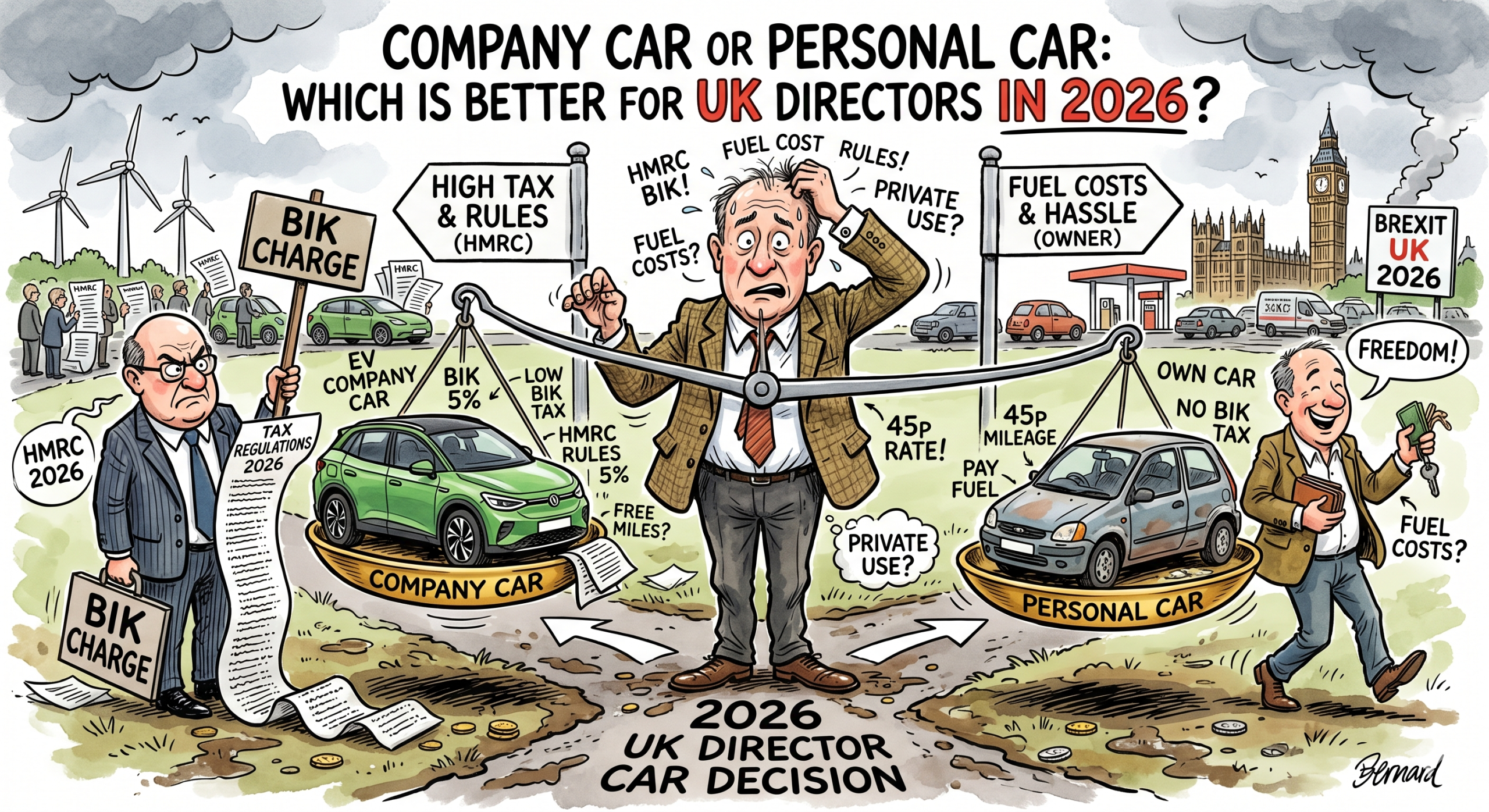
  • Company Car or Personal Car: A Tax Guide for UK Directors in 2026/2027

    When deciding between providing a company car or having a director use their personal vehicle for business, UK companies and their directors must consider the tax implications, administrative requirements, and the nature of the vehicle itself. The tax landscape for 2026/2027 continues to heavily favour certain types of vehicles over others, making a careful analysis essential.

    This guide breaks down the rules for both options, incorporating corrections based on current tax legislation and HMRC guidance.

    Company Car Tax Mechanics

    Providing a director with a car that is available for private use creates a taxable Benefit-in-Kind (BIK). The tax liabilities for both the director and the company are calculated based on this BIK value.

    Benefit-in-Kind (BIK) Calculation

    The BIK value is determined by multiplying the car’s list price (its P11D value) by a specific percentage, which is primarily based on the car’s carbon dioxide (CO2) emissions.

    • Director’s Tax: The director pays income tax on the BIK value at their marginal rate (e.g., 20%, 40%, or 45% in England and Northern Ireland for the 2025/26 tax year).
    • Company’s Tax: The company is liable for Class 1A National Insurance Contributions (NICs) on the same BIK value. The Class 1A NIC rate for the 2025/2026 tax year is 15% .

    Note: The following analysis will proceed based on the general principles and available data, but confirmation of the exact BIK rates for 2026/2027 would be required.

    Private Fuel Benefit

    If the company also pays for the director’s private fuel, a separate fuel benefit charge arises. This is calculated by applying the same BIK percentage to a fixed figure set by HMRC for the relevant tax year. The resulting amount is also subject to income tax for the director and Class 1A NICs for the company. The sources provided do not contain the fuel benefit charge multiplier for the 2026/2027 tax year.

    Company Relief: Capital Allowances

    A company purchasing a car can claim capital allowances to deduct the cost from its taxable profits. The type and rate of these allowances are strictly determined by the car’s CO2 emissions.

    100% First-Year Allowance (FYA)

    A 100% FYA allows the company to deduct the full cost of the asset in the year of purchase. This is a significant tax incentive, but it is narrowly defined for cars.

    • Eligibility: Under Section 45D of the Capital Allowances Act 2001 (CAA 2001), the 100% FYA is only available for expenditure on a new and unused car that is either electrically-propelled or has CO2 emissions of 0g/km.
    • Correction – No FYA for Hybrids: Contrary to the suggestion in your article, hybrid cars do not qualify for the 100% FYA, as their CO2 emissions are greater than 0g/km.
    • Time Limit: This allowance is available for qualifying expenditure incurred up to 31 March 2026 for companies subject to Corporation Tax.

    Writing Down Allowances (WDA)

    Cars that do not qualify for the 100% FYA are allocated to a capital allowances pool and receive WDAs on a reducing balance basis each year. The applicable pool and rate depend on the car’s CO2 emissions.

    • Main Rate Pool (18% WDA): For cars with CO2 emissions between 1g/km and 50g/km.
    • Special Rate Pool (6% WDA): For cars with CO2 emissions exceeding 50g/km.

    The 18% rate applies to the main rate pool, while the special rate pool has a lower WDA of 6%.

    Leasing a Company Car

    If a company leases a car rather than buying it, it cannot claim capital allowances. Instead, the lease rental payments are treated as a business expense.

    • Deductibility: The full rental cost is normally deductible from the company’s profits.
    • Lease Rental Restriction: However, if the CO2 emissions of the leased car exceed 50g/km, a 15% restriction applies. This means the company can only deduct 85% of the rental payments for tax purposes.

    Personal Car Tax Mechanics

    If a director uses their own car for business journeys, the company can reimburse them for the mileage. This system avoids BIK charges entirely.

    Mileage Allowance Payments (MAPs)

    Companies can make tax-free payments to directors for business mileage up to a certain approved amount. For the 2025/2026 tax year, the rates for cars and vans are:

    • 45p per mile for the first 10,000 business miles in the tax year.
    • 25p per mile for each business mile thereafter.

    These payments are received tax-free by the director and are a fully deductible expense for the company, reducing its Corporation Tax liability.

    Record Keeping

    HMRC requires detailed and accurate records of all business journeys for which mileage is claimed. This includes the date, purpose, start and end points, and the number of miles for each trip. Failure to keep adequate records or making inaccurate claims can lead to HMRC compliance checks and penalties for inaccuracies in a tax return or other document.

    Correct Scenarios for Directors

    Based on this analysis, the strategic choice for directors in 2026/2027 is as follows:

    • High-Mileage, Zero-Emission EV Driver: The company car route is highly attractive. The company can benefit from the 100% FYA (if purchased before 31 March 2026), and the director benefits from a low BIK rate. The company can also deduct all running costs (insurance, servicing, repairs). This combination often proves more tax-efficient than mileage claims for high-mileage drivers.
    • Hybrid or High-Emission Petrol/Diesel User: The personal car route is often more favourable.
    • Company Car Downsides: A company-owned hybrid or petrol/diesel car will attract a much higher BIK charge for the director. The company will not get the 100% FYA and will instead receive much slower tax relief through 18% or 6% WDAs. If leased, cars with emissions over 50g/km will have their rental deductions restricted.
    • Personal Car Advantages: Using a personal car and claiming mileage avoids the high BIK charges entirely. While the director bears the running costs personally, the tax-free mileage reimbursement provides a simple and often more tax-efficient alternative.
    • Low-Mileage Driver (Any Vehicle): For directors who travel very few business miles, the personal car option is typically better. The BIK tax on even a low-emission company car can easily exceed the value of tax-free mileage payments for low annual business mileage.
  • Pensions for Directors: Tax-Efficient Planning with Company Contributions

    For directors of limited companies, employer pension contributions represent a highly tax-efficient method of profit extraction. When structured correctly, these contributions can provide significant tax relief for the company while forming a key part of a director’s personal remuneration and retirement strategy.

    Corporation Tax Deductibility

    A pension contribution made by an employer to a registered pension scheme for a director is generally an allowable expense, deductible against the company’s profits for Corporation Tax purposes. However, this deduction is contingent on the contribution satisfying the ‘wholly and exclusively’ test, meaning it must be made solely for the purposes of the company’s trade.

    For a director who is also a shareholder of a close company, HMRC guidance stipulates that the entire remuneration package-which includes salary, bonuses, benefits, and pension contributions-must be considered. The total package must be commercially reasonable for the value of the work the director undertakes. If the overall remuneration is deemed excessive, HMRC may challenge the deductibility of the pension contribution, in part or in full, on the grounds that it was not paid wholly and exclusively for the purposes of the trade. To assess whether a remuneration package is reasonable, HMRC may compare it with packages paid to unconnected employees performing duties of similar value. In the absence of a suitable comparator, general principles regarding remuneration for directors and their relatives will be applied. It is therefore crucial for companies to be able to justify the commercial basis for a director’s entire remuneration package.

    Tax Treatment for the Director and the Pension Fund

    On Contribution: A significant advantage of employer pension contributions is that they are not treated as a taxable benefit for the director. This means there is no liability to Income Tax or National Insurance contributions for the director at the point the contribution is made by the company.

    Investment Growth: Once inside a registered pension scheme, the funds can grow in a tax-privileged environment. The tax rules provide for several important exemptions:

    • Income derived from investments or deposits held by the scheme is exempt from Income Tax.
    • Gains arising from the disposal of scheme investments are exempt from Capital Gains Tax.

    Inheritance Tax (IHT): Successive governments have provided generous tax reliefs to encourage pension savings. While this often results in pension funds falling outside of a person’s estate for IHT purposes, this is not a total exemption. There are circumstances where IHT charges can arise on a pension scheme, contributions made to it, or payments from it.

    Withdrawals from the Pension: Pension income, which includes payments from a scheme pension, lifetime annuity, or income withdrawal, is generally taxable on the individual receiving it in the tax year it accrues. The payer of the pension is required to operate the Pay As You Earn (PAYE) system on these payments.

    Individuals can typically start accessing their pension funds from the normal minimum pension age. For the 2026/27 tax year, this age is 55. This age is scheduled to rise to 57 on and after 6 April 2028.

    Pension Contribution Limits

    • Annual Allowance: There is a limit on the total amount of contributions that can be made to an individual’s pension schemes in a tax year while still benefiting from tax relief. This is known as the annual allowance. If contributions exceed this allowance, an annual allowance charge may be payable by the individual. In certain circumstances, an individual can elect for the pension scheme to pay this charge on their behalf, which is known as ‘scheme pays’.
    • Lifetime Allowance: The lifetime allowance charge was abolished with effect from 6 April 2024.

    Comparing Remuneration Methods

    When considering how to extract profits from a limited company, it is useful to compare the tax treatment of different methods:

    • Employer Pension Contribution: This is generally a deductible expense for the company’s Corporation Tax calculation, provided the ‘wholly and exclusively’ test is met. The director does not pay Income Tax or National Insurance on the contribution. The funds grow largely tax-free within the pension, and tax is paid by the director upon withdrawal in retirement.
    • Salary: This is also a deductible expense for Corporation Tax. However, the salary is subject to both employee’s and employer’s National Insurance contributions, as well as Income Tax for the director through PAYE.
    • Dividends: These are paid to shareholders out of the company’s post-Corporation Tax profits and are therefore not deductible for Corporation Tax. The director-shareholder is then liable to pay dividend income tax on the amount received, although there is no National Insurance on dividend payments.

    From a tax perspective, employer pension contributions are often the most efficient way to extract profit for retirement savings, as they attract Corporation Tax relief and avoid any immediate charge to Income Tax and National Insurance for the director. This contrasts with salary, which is subject to both IT and NI, and dividends, which are paid from profits that have already suffered Corporation Tax.

  • Key audit risks for mining companies

    Key audit risks for mining companies

    What are the key audit risks for mining companies?

    Some of the key challenges and key audit matters that come up regularly on our mining audits are outlined below, you can also verify this by reading the Key Audit Matters publicly disclosed in the audit reports of our AIM listed plc mining clients:

    Exploration and evaluation

    There is a risk that costs are not correctly capitalised as assets in accordance with IFRS6 exploration and evaluation s8-9. We review expenditure within both fixed assets and the P&L to ascertain whether they meet the criteria to be capitalised as exploration and evaluation assets, such as:

    (a) acquisition of rights to explore;

    (b) topographical, geological, geochemical and geophysical studies;

    (c ) exploratory drilling;

    (d) trenching;

    (e) sampling; and

    (f) activities in relation to evaluating the technical feasibility and commercial viability of extracting a mineral resource.

    Key audit risks for mining companies

    Development of the mine

    Once drilling and studies etc have shown that its commercially viable for mining, work may be needed to develop the mine. We would need to check that these costs are not capitalised within exploration and evaluation.

    We understand that mining is not an easy industry and sometimes things don’t go to plan. So we’d need to look into any the reasons for significant delays in developing a mining project or commencing production and how they’re being resolved.

    Extraction of mineral resources

    Once production has started we’d need to check that the capitalised assets are being correctly depreciated or amortised in line with the depletion rates.

    For risky materials such as gold we’d also need to perform anti money laundering testing to check that all the import/export and local taxes etc. are properly paid and everything is well documented.

    End of Life

    If the land is damaged during mining, then the local authorities are likely to require rehabilitation of the surrounding area. At the end of the mine’s life there could also be significant decommissioning costs involved to safely dismantle the mining site. We would check the estimated costs of these, and review any Environmental/Social plans and review if there are sufficient provisions recognised, check the calculations for discounting and present value etc.

    Impairment testing

    There is a risk that the carrying amount of capitalised mining project costs under IFRS6, Intangibles IAS38 or Tangibles IAS16 is less than than the fair value less costs to sell or the value in use. For early stage projects, we would review the latest results of sampling/studies and geologist reports and consider if there are any factors which suggest impairment or that the resources are not as expected or too difficult/costly to extract. For developed or producing assets we would need to review the discounted cashflows and their net present value and corroborate and challenge the key assumptions.

    Key audit risks for mining companies

    Physical assets

    We may also need to visit the site or alternatively work with local component auditors, in order to verify that the assets exist and to see the mine with our own eyes. If there is ROM (Run-of-Mine) extracted from the mine, then a year end inventory count may also be needed.

    Laws and regulations

    We would need to confirm that the Group has good title to the applicable exploration and mining licences or permits and whether they are in compliance with local rules and regulations.

  • Charging Your Company for Home Office Use: Rent vs. License Agreement

    For UK company directors working from home, charging the company for the use of a home office is a tax-efficient way to extract funds. This is typically achieved through either a formal rental (lease) agreement or a more flexible license to occupy. While both methods allow the company to claim a corporation tax deduction, they have significantly different implications for the director’s personal tax position, particularly concerning Capital Gains Tax (CGT).

    The Core Distinction: Exclusive vs. Non-Exclusive Use

    The choice between a lease and a license hinges on one critical factor: exclusive possession.

    • A Lease Agreement grants the company exclusive use of a specific part of the home (e.g., a dedicated office room). During the term of the lease, the director, in their personal capacity, cannot use that space. This creates a formal landlord-and-tenant relationship.
    • A License to Occupy grants the company permission to use a space, but not exclusively. The director retains overall control and can use the room for personal activities outside of business hours (e.g., as a guest room or study in the evenings). This does not create a formal tenancy.

    This distinction is the primary driver of the differing tax consequences.

    Option 1: The Formal Lease (Rental Agreement)

    Under this arrangement, the director acts as a landlord, and the company acts as a tenant.

    Tax Treatment for the Company: The rent paid by the company is a deductible expense for Corporation Tax, provided the rent is set at a commercial, “arm’s length” rate. This reduces the company’s taxable profits, resulting in a tax saving of 19% to 25%. The arrangement must be supported by a formal lease document and approved by a board resolution.

    Tax Treatment for the Director:

    • Income: The rent received is classified as property income and must be declared on a Self Assessment tax return (form SA105). It is subject to income tax at the director’s marginal rate (20%, 40%, or 45%).
    • Allowances & Deductions: The director can either claim the £1,000 tax-free property income allowance or deduct a proportion of actual household expenses against the rental income. Deductible expenses can include mortgage interest, council tax, utilities, insurance, and repairs.
    • National Insurance: Rental income is not subject to National Insurance Contributions (NICs).

    Significant Risks of a Lease Agreement:

    1. Loss of Principal Private Residence (PPR) Relief: This is the most substantial drawback. When the home is sold, the portion used exclusively for business will not qualify for PPR relief. This means a portion of the capital gain will be subject to CGT at the prevailing rates for residential property (currently 18% or 24%).
    2. Business Rates: The local council’s Valuation Office Agency (VOA) may assess the exclusively used business area for non-domestic business rates, creating an additional, ongoing liability.
    3. Administrative Burden: Requires a formal legal agreement, which may involve legal costs and adds a layer of compliance.

    Option 2: The License to Occupy

    This is a less formal arrangement granting the company permission to use a part of the home on a non-exclusive basis.

    Tax Treatment for the Company: The license fee paid is a deductible expense for Corporation Tax, just like rent. The fee must still be commercially justifiable and represent a reasonable apportionment of the costs of the space being used for business purposes. A simple license agreement and board minute are required for documentation.

    Tax Treatment for the Director:

    • Income: The license fee is classified as miscellaneous income. It is subject to income tax at the director’s marginal rate.
    • Allowances & Deductions: The director can claim the £1,000 tax-free trading and miscellaneous income allowance. Alternatively, if costs are higher, they can deduct expenses that are “wholly and exclusively” incurred in generating that income (i.e., an apportioned share of household running costs).
    • National Insurance: License fees are not subject to NICs.

    Key Advantages of a License Agreement:

    1. Preservation of PPR Relief: Because the business use is non-exclusive, the entire property typically remains eligible for full PPR relief upon sale, avoiding any CGT liability related to home office use.
    2. No Business Rates: Non-exclusive use of a room in a domestic property does not trigger a liability for business rates.
    3. Simplicity: The administrative and legal requirements are significantly lower than for a formal lease.

    Calculating a Defensible Charge

    Regardless of the method chosen, the amount charged to the company must be reasonable and based on actual costs. A common method is to calculate the total annual running costs of the home and apportion them based on the area used for business and the amount of time it is used.

    • Costs to Include: Utilities (gas, electricity, water), council tax, home insurance, and cleaning. If using a lease, a proportion of mortgage interest can also be included.
    • Apportionment: A typical method is to calculate the percentage of floor space the office occupies and then adjust for the proportion of time it is used for business.

    Example: A home has total relevant running costs of £5,000 per year. The office occupies 10% of the floor space and is used for business 50% of the time. A reasonable charge might be £5,000 x 10% x 50% = £250 per year. The calculation must be logical and defensible under HMRC scrutiny.

    If the licence fee charged to the company matches the director’s apportioned costs exactly, no income tax liability arises for the director (after deductions), while the company secures full corporation tax relief on the payment.

    Summary: Which is More Tax-Efficient?

    FeatureLease AgreementLicense to Occupy
    Company CT DeductionYes, if rent is at arm’s length.Yes, if fee is a reasonable share of costs.
    Director’s Income TypeProperty IncomeMiscellaneous Income
    Director’s Tax-Free Allowance£1,000 Property Allowance£1,000 Miscellaneous Income Allowance
    PPR Relief on Home SaleLost for the exclusive business portion.Preserved in full.
    Capital Gains Tax RiskHigh. A CGT charge is likely on sale.Minimal to None.
    Business Rates RiskYes. The space can be assessed.No.
    AdministrationHigher (formal lease required).Lower (simple agreement sufficient).
    NI ContributionsNoneNone

  • Dividends vs Salary, How Directors Should Plan Income in 2026

    For UK company directors, determining the most tax-efficient method of remuneration is a critical annual exercise. The classic “low salary, high dividend” strategy remains a cornerstone of tax planning, but its effectiveness depends on evolving tax rates, allowances, and National Insurance thresholds. This guide provides a strategic overview for directors planning their income for the 2026/27 tax year. While the exact rates and thresholds for 2026/27 are subject to future government budgets, planning can be based on the latest confirmed figures. This article uses the rates and allowances for the 2024/25 tax year as the basis for forward planning, noting that key thresholds like the Personal Allowance have been frozen until 2028.

    Key Tax Figures for Planning (2026/27 rates)

    Understanding the key thresholds is fundamental to effective remuneration planning.

    Corporation Tax: The main rate remains 25% for companies with profits over £250,000. A small profits rate of 19% applies to profits up to £50,000, with marginal relief applying between £50,001 and £250,000.

    Personal Allowance: £12,570. Income up to this amount is free of Income Tax. This threshold is frozen until April 2028.

    Dividend Allowance: £500. The first £500 of dividend income is tax-free.

    Dividend Tax Rates:

    • Basic Rate: 8.75%
    • Higher Rate: 33.75%
    • Additional Rate: 39.35%

    National Insurance Contributions (NICs):

    Lower Earnings Limit (LEL): £6,396 per year. Earnings above this level qualify for State Pension credits.

    Secondary Threshold (ST): £9,100 per year. Employer NICs are due on salary above this level.

    Primary Threshold (PT): £12,570 per year. Employee NICs are due on salary above this level.

    Employment Allowance: £5,000 per year. This can be used by eligible employers to offset their employer NICs liability. It is not available for companies where the sole employee is also a director.

    Core Principles: Salary, Dividends, and Pensions

    A tax-efficient strategy balances three key components:

    Pensions: Company contributions into a director’s pension are typically a fully deductible expense for Corporation Tax purposes. They also face no Income Tax or NICs for the director upon contribution, making them the most tax-efficient way to extract profits for long-term savings.

    Salary: A director’s salary is a deductible expense for the company, reducing its Corporation Tax bill. A salary paid above the Lower Earnings Limit (£6,396) but below the Primary Threshold (£12,570) allows the director to build a qualifying year for the State Pension without paying any Employee NICs.

    Dividends: Paid out of post-tax profits, dividends are not subject to National Insurance, making them highly attractive. They are taxed at lower rates than salary income, especially within the basic rate band.

    Optimal Salary Strategies for Directors

    The optimal salary level depends on whether the company is eligible for the Employment Allowance.

    Scenario 1: Company IS Eligible for the Employment Allowance

    Recommended Salary: £12,570

    If your company has at least one other employee (besides the director), you are likely eligible for the Employment Allowance. The optimal strategy is to set the director’s salary at £12,570.

    Director’s Position: Receives the salary completely free of Income Tax (within the Personal Allowance) and Employee NICs (at the Primary Threshold). They also secure a qualifying year for the State Pension.

    Company’s Position: The salary is a deductible expense, saving Corporation Tax. While this salary level is above the Secondary Threshold (£9,100), the resulting Employer NICs liability can be covered by the £5,000 Employment Allowance.

    Scenario 2: Company is NOT Eligible for the Employment Allowance (e.g., a Sole Director)

    Recommended Salary: £9,100

    For a company where the only employee on the payroll is a director, the Employment Allowance is not available. Paying a salary of £12,570 would trigger an unnecessary Employer NICs charge.

    The optimal strategy is therefore to set the salary at the Secondary Threshold of £9,100.

    Director’s Position: The salary is tax-free and NIC-free. Crucially, as it is above the Lower Earnings Limit (£6,396), it still provides a qualifying year for the State Pension.

    Company’s Position: The company avoids any Employer NICs liability while still benefiting from Corporation Tax relief on the £9,100 salary.

    The remainder of the director’s income should be extracted as dividends.

    Maximising Take-Home Pay with Dividends and Pensions

    Using Dividends Efficiently

    Once the optimal salary is set, profits can be extracted as dividends. After the company pays Corporation Tax, the director can receive:

    • The first £500 of dividends tax-free (using the Dividend Allowance).
    • Further dividends are taxed at 8.75% until total income reaches the higher rate threshold (£50,270).

    This combination remains significantly more tax-efficient than taking a higher salary, which would attract both higher rates of income tax and employee NICs.

    Key Takeaways for Directors

    Check Eligibility for Employment Allowance: This is the first step. It determines whether your optimal salary is £12,570 or £9,100.

    Pay the Right Salary: Set your salary at the optimal level (£12,570 or £9,100) to secure State Pension credits with minimal or zero NICs.

    Utilise Dividends: Extract further profits as dividends, taking advantage of the £500 allowance and the 8.75% basic rate.

    Don’t Forget Pensions: For profits above £50,000, consider making significant employer pension contributions to mitigate higher-rate dividend tax and reduce your company’s Corporation Tax bill.

    Plan Ahead: Tax thresholds are frozen, which means more directors will be pushed into higher tax bands as their profits grow. Proactive planning with an accountant is essential.

    Frequently Asked Questions

    What is the most tax-efficient salary for a director in 2026/27?

    Based on current rules, it is £12,570 if the company can claim the Employment Allowance, and £9,100 if it cannot (e.g., for a sole director).

    Are dividends still more tax-efficient than salary?

    Yes. For most directors, a low salary and high dividend structure remains more efficient than taking a large salary, primarily due to the savings on National Insurance.

    What are the limits on pension contributions?

    The standard annual allowance is £60,000. This can be tapered down for individuals with an ‘adjusted income’ over £260,000. You may also be able to carry forward unused allowances from the previous three tax years.

    What if my company has no profits?

    Dividends can only be paid from retained profits. If there are no profits, you can only take a salary. If the company makes a loss, this can typically be carried forward to offset against future profits.


  • Directors Loan Accounts Explained, Risks, Tax Charges and Best Practice

    Director’s Loan Accounts (DLAs) are a common feature in UK owner-managed businesses, offering a flexible way to handle funds between a director and their limited company. However, they are subject to strict HMRC regulations and can trigger significant tax charges if not managed correctly. This guide provides a comprehensive overview of the rules, potential tax liabilities, and best practices for maintaining compliance.

    The Personal Tax Charge: Benefit in Kind (BIK)

    In addition to the company’s potential S455 liability, the director may face a personal tax charge if they receive a “beneficial loan” from the company.

    Trigger: A benefit in kind (BIK) arises if the total outstanding loan to a director exceeds £10,000 at any point during the tax year, and the director pays no interest, or pays interest at a rate below HMRC’s ‘official rate of interest’.

    Calculation: The taxable benefit is calculated by applying the official rate of interest to the loan amount for the period it was outstanding.

    HMRC Official Rate of Interest: For the 2024/25 tax year, this rate is 2.25%. This rate is reviewed annually and can change.

    Tax Consequences:

    1. Income Tax for the Director: The calculated benefit is treated as part of the director’s employment income and is subject to income tax at their marginal rate.

    2. National Insurance for the Company: The company is required to pay Class 1A National Insurance Contributions (NICs) on the full value of the benefit. The rate for 2024/25 is 13.8%.

    Avoiding the BIK: This tax charge can be avoided entirely if the director pays interest on the loan to the company at a rate equal to or greater than HMRC’s official rate.

    Key Risks and Anti-Avoidance Rules

    1. Cash Flow Impact: The 33.75% S455 charge represents a significant cash outflow for the company. While refundable, the delay in reclaiming the tax can strain working capital.

    2. “Bed & Breakfasting” (Loan Recycling): HMRC has specific anti-avoidance rules (s464C CTA 2010) to prevent directors from repaying a loan just before the S455 deadline only to withdraw the funds again shortly after.

    The 30-Day Rule: If a director repays £5,000 or more of a loan and then, within 30 days, withdraws £5,000 or more, the repayment is matched to the new withdrawal. This means the original loan is treated as not having been repaid, and the S455 charge will still apply.

    Arrangements Rule: This rule is broader and applies where, at the time of a repayment, there is an arrangement for a future withdrawal.

    3. Insolvency Risk: If a company becomes insolvent, an overdrawn DLA is considered an asset that the insolvency practitioner is legally obligated to recover for the benefit of the company’s creditors. This means the director is personally liable to repay the debt to the company. The protection of limited liability does not apply to this personal debt.

    4. Disclosure Requirements: Under the Companies Act 2006, details of any loans to directors must be disclosed in the notes to the company’s annual accounts, regardless of the amount.

    What is a Director’s Loan Account?

    A DLA is a record kept in the company’s accounts that tracks all money taken from or paid into the company by a director, outside of regular salary, dividends, or expense repayments.

    DLA in Credit: When a director lends money to the company, the DLA is in credit. The company owes the director money, and this is treated as a liability on the company’s balance sheet.

    DLA Overdrawn: When a director borrows money from the company, the DLA is overdrawn. The director owes the company money, creating a company asset. It is this overdrawn status that attracts HMRC’s attention and can lead to tax charges.

    The Corporate Tax Charge: Section 455

    If a director’s loan is not repaid in full by a specific deadline, the company itself is liable for a substantial tax charge under Section 455 of the Corporation Tax Act 2010 (CTA 2010).

    Trigger: The charge applies if the DLA is still overdrawn nine months and one day after the company’s financial year-end.

    The Rate:

    • For loans made on or after 6 April 2022, the S455 tax rate is 33.75%.
    • For loans made between 6 April 2016 and 5 April 2022, the rate is 32.5%.

    This rate is intentionally high as it is linked to the dividend upper tax rate, discouraging directors from using loans as a long-term, tax-free method of extracting profits. This tax is payable by the company as part of its Corporation Tax liability and is reported on the CT600A supplementary form.

    Is S455 Tax Refundable?

    Yes, S455 tax is a temporary charge. The company can reclaim the tax it has paid once the underlying loan has been repaid, written off, or released.

    However, the reclaim process is not immediate. A claim for repayment cannot be made until nine months and one day after the end of the corporate accounting period in which the loan was repaid. This can lead to a significant cash flow disadvantage for the company, as the funds can be tied up with HMRC for a considerable time.

    Best Practices for Managing DLAs

    Repay with External Funds: To avoid falling foul of the “bed & breakfasting” rules, it is safest to repay a DLA using personal funds that are not immediately drawn back out of the company.

    Maintain Meticulous Records: Use accounting software to track every transaction flowing through the DLA to ensure the balance is always known and accurate.

    Formalise Loans: For any significant loan, create a formal loan agreement that is approved by the board and recorded in the company’s minutes. This should specify the loan amount, interest rate, and repayment terms.

    Monitor the £10,000 BIK Threshold: If a director’s loan is approaching or exceeds £10,000, ensure interest is charged at the official rate and paid by the director to avoid BIK charges.

    Respect the 9-Month Deadline: The most critical deadline is nine months and one day after the financial year-end. Plan to clear any overdrawn balance before this date to prevent the S455 charge.

    Plan Profit Extraction: Consider whether a loan is the best method for extracting funds. Often, a combination of salary and dividends is more tax-efficient and administratively simpler.

    Summary of Key Rates & Thresholds (2024/25)

    S455 Tax Rate (Loans from 06/04/22)33.75%
    S455 Repayment Deadline9 months and 1 day after year-end
    BIK Loan Threshold£10,000
    HMRC Official Rate of Interest (BIK)2.25%
    Company Class 1A NICs on BIK13.8%

  • A Guide to UK Tax Rates and Thresholds for 2026/27

    The 2026/27 UK tax year, which runs from 6 April 2026 to 5 April 2027, is expected to see a continuation of the government’s policy of freezing many key tax thresholds. While this provides a degree of certainty, the freeze means that as incomes rise with inflation, more individuals and businesses will be drawn into higher tax brackets.

    This guide provides an overview of the main rates and thresholds announced for 2026/27, which are essential for effective tax planning by sole traders, limited company directors, employers, and employees.

    Who this guide is for:

    • Sole traders planning for Self Assessment and payments on account.
    • Limited company directors structuring their remuneration through salary and dividends.

    Employers and employees managing PAYE and National Insurance obligations.

    Income Tax Rates and Bands (England, Wales, and Northern Ireland)

    The UK-wide Personal Allowance remains frozen at £12,570. This is the amount of income you can earn before you start paying Income Tax.

    The Personal Allowance is reduced by £1 for every £2 of “adjusted net income” over £100,000. This means the allowance is fully withdrawn for individuals with an income of £125,140 or more.

    The Income Tax rates and bands for England, Wales, and Northern Ireland are as follows:

    BandTaxable IncomeTax Rate
    Basic Rate£12,571 to £50,27020%
    Higher Rate£50,271 to £125,14040%
    Additional RateOver £125,14045%

    Scottish Income Tax

    It is important to note that Scotland sets its own Income Tax rates and bands for non-savings and non-dividend income. While the UK-wide Personal Allowance applies, the thresholds and rates for Scottish taxpayers differ from those in the rest of the UK.

    Dividend Tax (UK-wide)

    For directors and shareholders, the tax treatment of dividends is a key consideration.

    Dividend Allowance: The tax-free Dividend Allowance is £500. This allowance does not reduce total income for the purposes of determining your tax band.

    Dividend Tax Rates: Dividends received above the £500 allowance are taxed at the following rates:

    • 8.75% for basic rate taxpayers.
    • 33.75% for higher rate taxpayers.
    • 39.35% for additional rate taxpayers.

    National Insurance Contributions (NICs)

    The rates and thresholds for National Insurance for 2026/27 are outlined below.

    Employees (Class 1 NICs)

    BandTaxable IncomeTax Rate
    Basic Rate£12,571 to £50,27020%
    Higher Rate£50,271 to £125,14040%
    Additional RateOver £125,1404Employees (Class 1 NICs)
    Earnings per year
    NICs Rate
    Up to £12,570
    0%
    £12,570.01 to £50,270
    8%
    Over £50,270
    2%

    Employers (Class 1 NICs)

    Employers pay Class 1 NICs at a rate of 13.8% on an employee’s earnings above the Secondary Threshold of £9,100 per year (£175 per week).

    Self-Employed (Class 2 and Class 4 NICs)

    Class 4 NICs:

    Annual ProfitsNICs Rate
    £12,570 to £50,2706%
    Over £50,2702%

    Class 2 NICs: Compulsory Class 2 NICs were abolished from 6 April 2024.

    • Self-employed individuals with profits above £12,570 are treated as having made contributions, protecting their entitlement to the State Pension and other benefits without needing to make a payment.
    • Those with profits below the Small Profits Threshold (£6,725 in 2024/25) can make voluntary Class 2 contributions to protect their National Insurance record.

    Corporation Tax

    For limited companies, Corporation Tax is charged on annual profits. The rates are tiered:

    • Small Profits Rate: 19% on profits up to £50,000.
    • Main Rate: 25% on profits over £250,000.
    • Marginal Relief: Companies with profits between £50,001 and £250,000 can claim Marginal Relief, resulting in a gradual increase in the effective tax rate from 19% to 25%.

    Value Added Tax (VAT)

    The key VAT thresholds are:

    • Registration Threshold: Businesses must register for VAT if their VAT-taxable turnover exceeds £90,000 in a rolling 12-month period.
    • Deregistration Threshold: A business can apply to deregister if its taxable turnover is expected to be £88,000 or less over the next 12 months.

    The main VAT rates remain:

    Zero Rate: 0%

    Standard Rate: 20%

    Reduced Rate: 5%

    A Guide to UK Tax Rates and Thresholds for 2026/27

    Disclaimer:

    The rates and thresholds provided are based on government announcements for the 2026/27 tax year and are correct at the time of writing. These figures are subject to change in future UK Budgets or fiscal statements.

  • Use of Home as Office, How Much Can UK Directors and Sole Traders Claim?

    UK home office expenses directors sole traders claim

    Overview of Home Office Expenses
    The rules for claiming tax relief on home office expenses differ significantly for self-employed individuals (sole traders and partners) and company directors, who are treated as employees of their companies. A major change, announced in the Budget 2025, affects the ability of employees and directors to claim these expenses from the 2026-27 tax year onwards.

    Rules for Sole Traders and Partnerships (Self-Employed)
    Self-employed individuals who work from home can claim a deduction for the costs incurred. There are two methods for calculating this deduction: using a simplified flat rate or claiming a proportion of actual costs.

    1. Simplified Flat Rate Method
    This method allows for a flat-rate deduction based on the number of hours spent working from home each month on core business activities, such as providing goods or services, maintaining records, and marketing.

    Eligibility: This option is available if you work 25 or more hours per month

    Rates for 2026-27:

    The monthly flat rates are:

    £10 for 25 to 50 hours worked from home

    £18 for 51 to 100 hours worked from home

    £26 for 101 or more hours worked from home

    What it Covers: The flat rate covers household running costs, such as heat, light, and power.

    Additional Claims: Even when using the flat rate, you can still make separate claims for:

    Fixed costs, such as a proportion of Council Tax, mortgage interest, and insurance, where an identifiable part of the home is used for business.

    The business proportion of telephone and broadband costs.

    2. Actual Costs Method

    Alternatively, you can claim a proportion of your actual household costs. This requires calculating the business element of your home expenses, typically by apportioning them based on the area of your home used for business and the amount of time it is used for that purpose.

    Claimable Costs Include:

    Fixed Costs: A proportion of costs that relate to the whole house, such as:

    • Council Tax Mortgage interest (but not capital repayments)
    • Rent (if you rent your home)
    • Insurance
    • General repairs and maintenance (e.g., exterior painting).
      A deduction for these costs is generally allowed if part of the home is set aside solely for trade use for a specific period.

    Running Costs: Expenses that may vary with business use, such as:

    • Heating, lighting, and power
    • Cleaning
    • Metered water (if there is business use of water)

    Repairs: The cost of repairs that relate solely to a part of the house used exclusively for business (e.g., redecorating a home office) is wholly allowable. A proportion of general household repairs can also be claimed.

    Telephone and Broadband: These are not treated as household expenses but can be claimed separately. The allowable amount includes the cost of business calls and a proportion of the line rental and broadband connection costs based on the ratio of trade use to total use. If private use of the connection is not significant, the full cost may be claimed.

    Exclusive Use: The term “exclusively” or “solely” for business purposes does not necessarily mean a room can never have any other use. HMRC guidance provides an example of an author who uses her living room for business for four hours a day and whose family uses it in the evening. In this case, a deduction is calculated by apportioning the costs by both area and time, demonstrating that mixed-use spaces can still generate a valid claim if a clear business-use period can be identified and evidenced.

    Rules for Company Directors (as Employees)

    Company directors are treated as employees, and the rules for them are different and more restrictive.

    The Position from 6 April 2026
    The Budget 2025 announced that the income tax deduction for non-reimbursed homeworking expenses for employees will be removed from 6 April 2026. This means that from the 2026-27 tax year, directors will no longer be able to make a standalone claim for homeworking costs on their Self Assessment tax returns. From this date, tax relief for homeworking expenses will only be available through reimbursement from the employer company.

    Employer Reimbursements (Section 316AIΤΕΡΑ 2003)
    A company can make tax-free payments to a director for the reasonable additional household expenses they incur while carrying out their duties at home.

    This is permitted under the following conditions:

    • There must be “homeworking arrangements” in place, meaning an agreement between the director and the company for the director to regularly perform some or all of their duties at home.
    • The payment must cover “household expenses,” which are defined as expenses connected with the day-to-day running of the director’s home. This typically refers to the additional costs of heating and electricity.
    • The amount must be “reasonable”. An employer can pay a flat rate set by HMRC or reimburse the actual additional costs incurred, which would need to be evidenced.

    HMRC guidance indicates that it is difficult for directors, particularly of service companies, to meet these tests. A claim would generally only be accepted where there was an objective requirement to work from home, for example, because the client did not provide premises and there was no other location where the work could be done.

    Record Keeping

    • Sole Traders (Actual Costs): You must keep records to support your claim, including utility bills, mortgage or rent statements, and the calculations for your apportionment.
    • Sole Traders (Flat Rate): You do not need to keep receipts for the costs covered by the flat rate, but you must be able to evidence the number of hours you worked from home.
    • Directors: If the company reimburses more than the HMRC-approved flat rate, records of the actual additional costs must be kept to demonstrate that the payment was reasonable and no tax liability arises.

    Cited sources

    1. https://www.legislation.gov.uk/ukpga/2003/1/section/316A
    2. https://www.legislation.gov.uk/ukpga/2003/1/section/336