
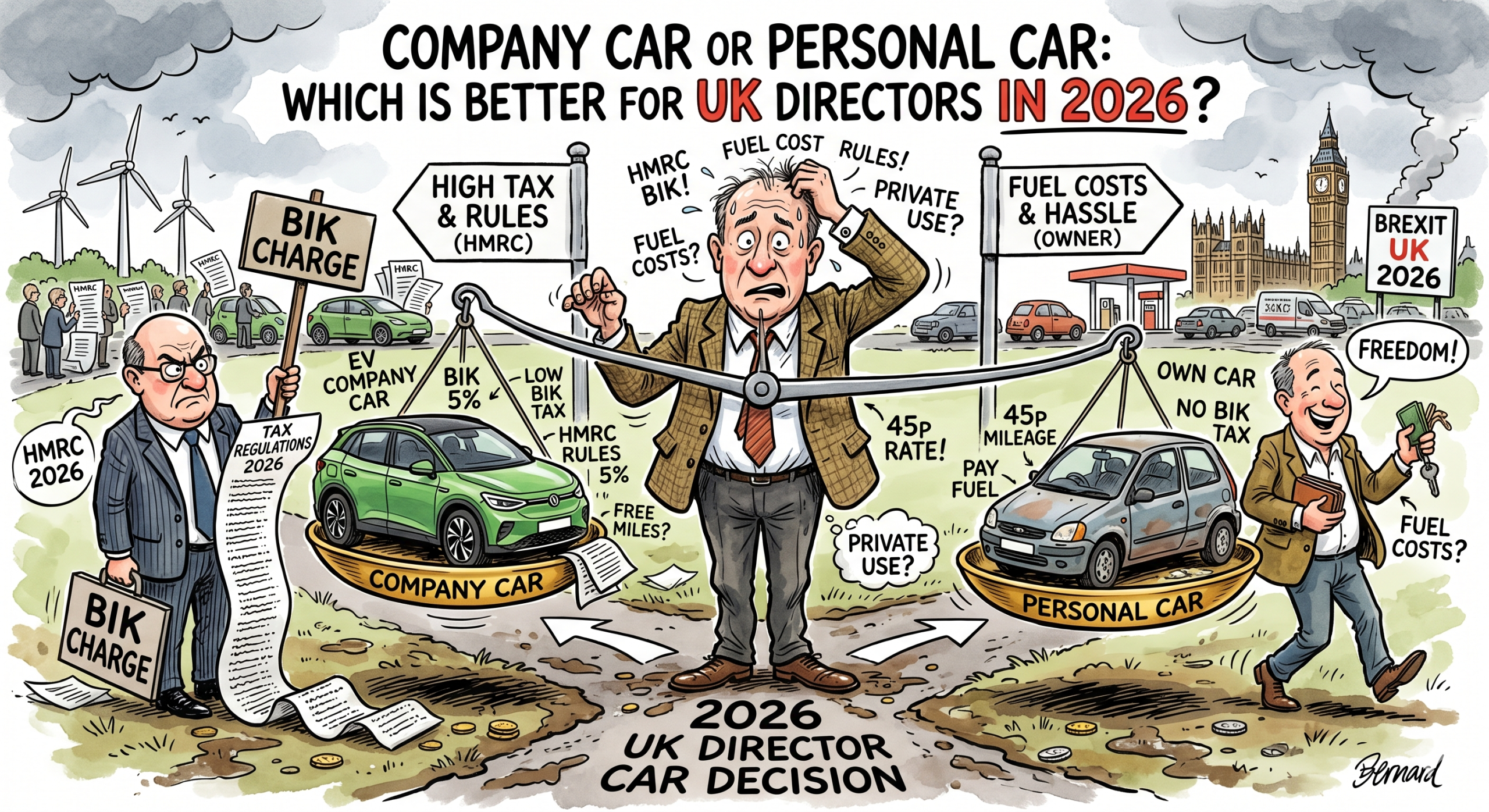
When deciding between providing a company car or having a director use their personal vehicle for business, UK companies and their directors must consider the tax implications, administrative requirements, and the nature of the vehicle itself. The tax landscape for 2026/2027 continues to heavily favour certain types of vehicles over others, making a careful analysis essential.
This guide breaks down the rules for both options, incorporating corrections based on current tax legislation and HMRC guidance.
Company Car Tax Mechanics
Providing a director with a car that is available for private use creates a taxable Benefit-in-Kind (BIK). The tax liabilities for both the director and the company are calculated based on this BIK value.
Benefit-in-Kind (BIK) Calculation
The BIK value is determined by multiplying the car’s list price (its P11D value) by a specific percentage, which is primarily based on the car’s carbon dioxide (CO2) emissions.
- Director’s Tax: The director pays income tax on the BIK value at their marginal rate (e.g., 20%, 40%, or 45% in England and Northern Ireland for the 2025/26 tax year).
- Company’s Tax: The company is liable for Class 1A National Insurance Contributions (NICs) on the same BIK value. The Class 1A NIC rate for the 2025/2026 tax year is 15% .
Note: The following analysis will proceed based on the general principles and available data, but confirmation of the exact BIK rates for 2026/2027 would be required.
Private Fuel Benefit
If the company also pays for the director’s private fuel, a separate fuel benefit charge arises. This is calculated by applying the same BIK percentage to a fixed figure set by HMRC for the relevant tax year. The resulting amount is also subject to income tax for the director and Class 1A NICs for the company. The sources provided do not contain the fuel benefit charge multiplier for the 2026/2027 tax year.
Company Relief: Capital Allowances
A company purchasing a car can claim capital allowances to deduct the cost from its taxable profits. The type and rate of these allowances are strictly determined by the car’s CO2 emissions.
100% First-Year Allowance (FYA)
A 100% FYA allows the company to deduct the full cost of the asset in the year of purchase. This is a significant tax incentive, but it is narrowly defined for cars.
- Eligibility: Under Section 45D of the Capital Allowances Act 2001 (CAA 2001), the 100% FYA is only available for expenditure on a new and unused car that is either electrically-propelled or has CO2 emissions of 0g/km.
- Correction – No FYA for Hybrids: Contrary to the suggestion in your article, hybrid cars do not qualify for the 100% FYA, as their CO2 emissions are greater than 0g/km.
- Time Limit: This allowance is available for qualifying expenditure incurred up to 31 March 2026 for companies subject to Corporation Tax.
Writing Down Allowances (WDA)
Cars that do not qualify for the 100% FYA are allocated to a capital allowances pool and receive WDAs on a reducing balance basis each year. The applicable pool and rate depend on the car’s CO2 emissions.
- Main Rate Pool (18% WDA): For cars with CO2 emissions between 1g/km and 50g/km.
- Special Rate Pool (6% WDA): For cars with CO2 emissions exceeding 50g/km.
The 18% rate applies to the main rate pool, while the special rate pool has a lower WDA of 6%.
Leasing a Company Car
If a company leases a car rather than buying it, it cannot claim capital allowances. Instead, the lease rental payments are treated as a business expense.
- Deductibility: The full rental cost is normally deductible from the company’s profits.
- Lease Rental Restriction: However, if the CO2 emissions of the leased car exceed 50g/km, a 15% restriction applies. This means the company can only deduct 85% of the rental payments for tax purposes.
Personal Car Tax Mechanics
If a director uses their own car for business journeys, the company can reimburse them for the mileage. This system avoids BIK charges entirely.
Mileage Allowance Payments (MAPs)
Companies can make tax-free payments to directors for business mileage up to a certain approved amount. For the 2025/2026 tax year, the rates for cars and vans are:
- 45p per mile for the first 10,000 business miles in the tax year.
- 25p per mile for each business mile thereafter.
These payments are received tax-free by the director and are a fully deductible expense for the company, reducing its Corporation Tax liability.
Record Keeping
HMRC requires detailed and accurate records of all business journeys for which mileage is claimed. This includes the date, purpose, start and end points, and the number of miles for each trip. Failure to keep adequate records or making inaccurate claims can lead to HMRC compliance checks and penalties for inaccuracies in a tax return or other document.
Correct Scenarios for Directors
Based on this analysis, the strategic choice for directors in 2026/2027 is as follows:
- High-Mileage, Zero-Emission EV Driver: The company car route is highly attractive. The company can benefit from the 100% FYA (if purchased before 31 March 2026), and the director benefits from a low BIK rate. The company can also deduct all running costs (insurance, servicing, repairs). This combination often proves more tax-efficient than mileage claims for high-mileage drivers.
- Hybrid or High-Emission Petrol/Diesel User: The personal car route is often more favourable.
- Company Car Downsides: A company-owned hybrid or petrol/diesel car will attract a much higher BIK charge for the director. The company will not get the 100% FYA and will instead receive much slower tax relief through 18% or 6% WDAs. If leased, cars with emissions over 50g/km will have their rental deductions restricted.
- Personal Car Advantages: Using a personal car and claiming mileage avoids the high BIK charges entirely. While the director bears the running costs personally, the tax-free mileage reimbursement provides a simple and often more tax-efficient alternative.
- Low-Mileage Driver (Any Vehicle): For directors who travel very few business miles, the personal car option is typically better. The BIK tax on even a low-emission company car can easily exceed the value of tax-free mileage payments for low annual business mileage.